Condo Water Bills in Thailand: How to Pay and What to Check
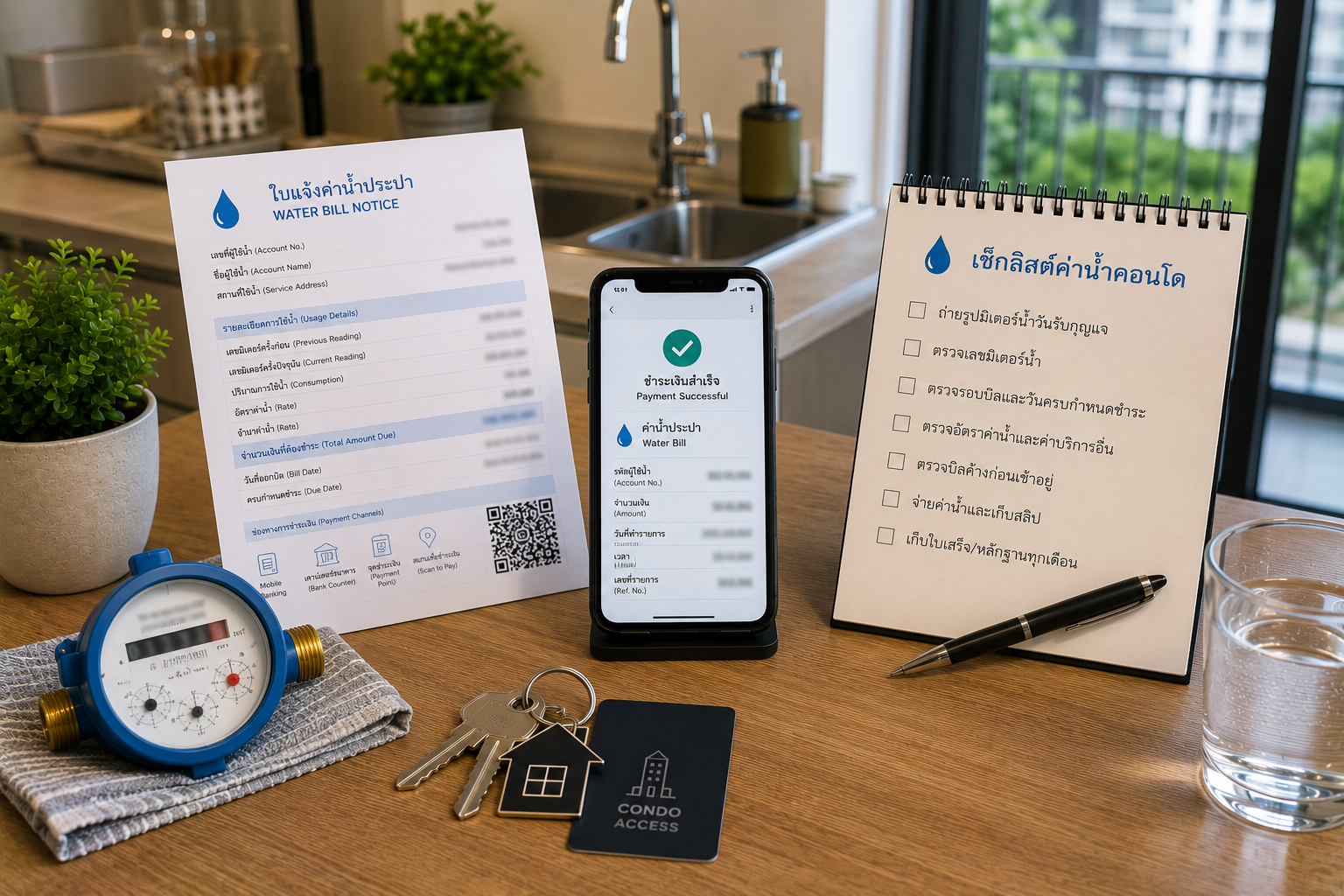
Condo water bills in Thailand may seem like a smaller expense than electricity, but they often cause confusion. This is especially true for rented units: some condominiums bill for water through the juristic office, some owners collect the charge, and in some areas a water authority such as the MWA or PWA may be directly involved. If these details are not checked from the first day, problems may arise from an incorrect meter reading, bills outstanding before move-in, water leaks, unusually high charges, or a lack of payment proof when moving out.
This article is a general guide for people moving into condominiums in Bangkok, Nonthaburi, Samut Prakan, Pattaya, Chonburi, Phuket, Chiang Mai, Hua Hin, and other provinces. It focuses on what to check about condo water charges, including the water meter, how charges are calculated, billing cycles, payment channels, no water or low water pressure, and keeping proof of every monthly payment.
English summary: Condo water bills in Thailand may be paid through the juristic office, landlord, MWA, or PWA. Always check meter readings, billing method, payment proof, leaks, and unpaid bills.
1. Condo Water Charges Are Not Always Paid Directly to the Water Authority
Many condominiums first collect water charges through the condominium juristic office, which then handles payment to the relevant authority or manages the building's internal system. In some cases, the owner receives the bill and collects payment from the tenant. In other areas, the water user may be able to pay the water authority directly. This depends on the project and the building's meter system.
- Are water charges paid through the juristic office?
- Are water charges paid through the unit owner?
- Is there a bill directly from the MWA or PWA?
- What is the water rate per unit?
- Are there service charges, meter maintenance fees, or other fees?
- Is the water-charge calculation stated in the lease or juristic office documents?
The MWA is the Metropolitan Waterworks Authority serving Bangkok, Nonthaburi, and Samut Prakan. It provides MWA Call Center 1125 and e-services. The PWA is the Provincial Waterworks Authority serving many provincial areas and offers the 1662 customer-service channel for no-water and low-pressure problems within its service areas. :contentReference[oaicite:0]{index=0}
English summary: Many condos collect water fees through the juristic office or landlord, so do not assume you can always pay directly to the water authority.
2. Photograph the Water Meter When You Receive the Keys
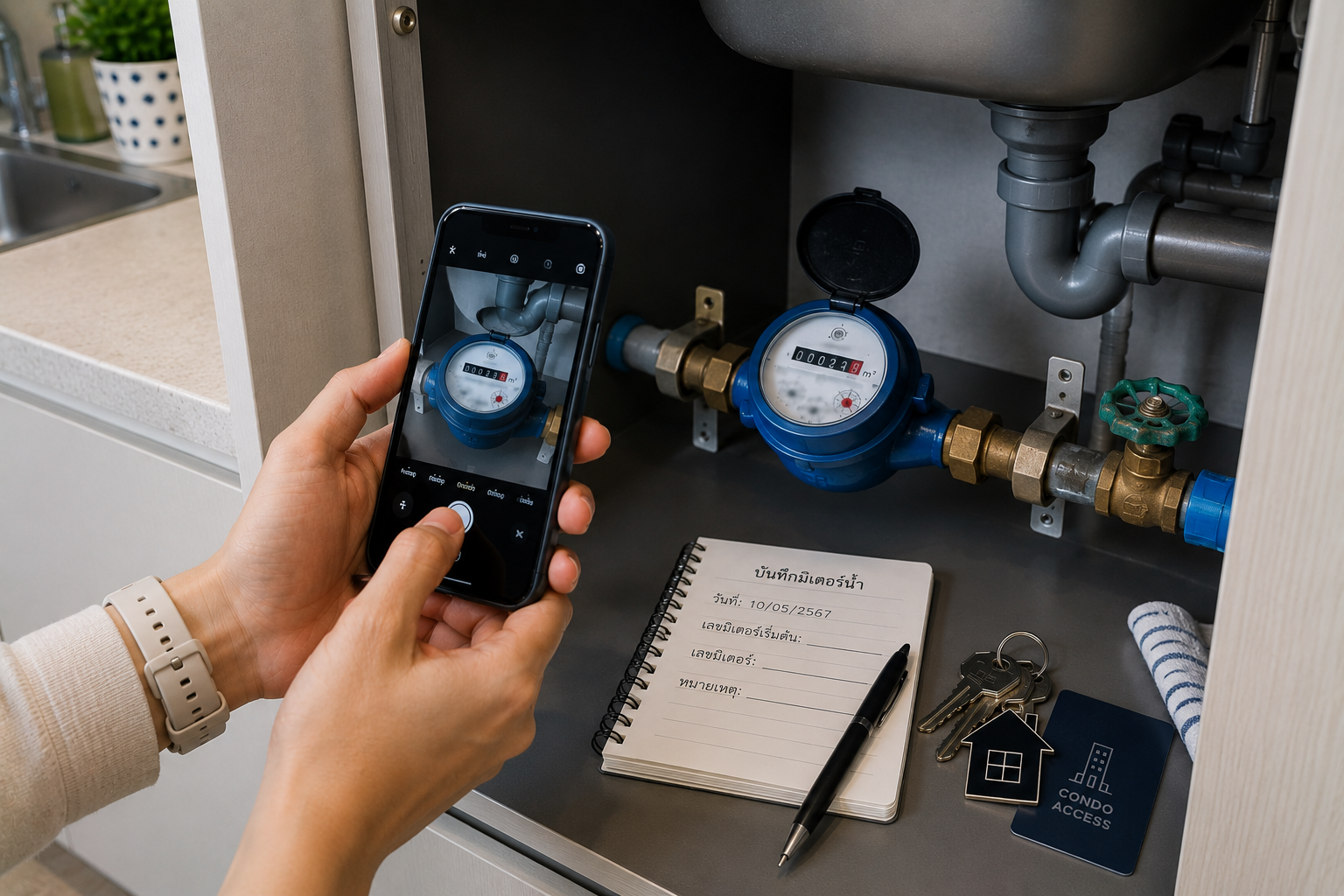
The first day's water-meter reading is very important evidence, especially for a rented unit. It separates water charges incurred before move-in from those incurred after the tenant begins using the unit. Take a clear photograph of the water meter on the day the keys are received or on move-in day, and immediately send it to the owner in chat.
- Photograph the water meter with every digit visible.
- Take the photograph when receiving the keys or moving in.
- Send the photograph to the owner or landlord that same day.
- Ask the owner to confirm the starting reading.
- Keep the photograph in the folder containing the rental documents.
- Use it to compare against the first water bill after move-in.
If the water meter is in a service room or an area the tenant cannot enter, ask the juristic office or owner to photograph it and confirm the reading in writing. Do not accept only a verbal meter reading.
3. Check Whether Charges Use the Unit Meter or a Shared Meter
Some condominiums have a separate water meter for each unit, while other buildings may collect charges through a method connected to the building's shared system. Tenants should clearly ask which meter is used to calculate their unit's water charge and whether they can check the reading themselves.
- Does the unit have a separate water meter?
- Is the meter inside the unit, in the corridor, or in a building service room?
- Can the tenant check the meter reading?
- Does the juristic office read the meter every month?
- Is there a photograph or statement showing the opening and closing readings?
- Who should be notified if the meter reading does not match?
If water charges are paid through the juristic office, ask whether the meter-reading details can be reviewed, especially for the first month and the final month before moving out.
English summary: Confirm whether your water bill is based on your unit's own meter or building-level calculation.
4. Check the Billing Cycle and Water-Bill Due Date
The water bill may not be issued on the same date as the electricity bill or rent. Some condominiums issue monthly bills through the juristic office, while others combine water with charges such as common-area fees, parking fees, or building service fees. Residents should record the billing cycle clearly from the first month.
- Approximately what day of the month is the water bill issued?
- What is the payment due date?
- Is there a penalty for late payment?
- Is water included with other building charges or billed separately?
- Must payment be made at the juristic office or by bank transfer?
- Who must receive the payment slip after payment?
Set reminders on your phone for water and other bills because some buildings may impose penalties or restrictions for late payment. Check these conditions directly with the juristic office or in the lease.
5. Check for Outstanding Bills Before Move-In
Before paying the first bill, ask the owner or landlord whether any water charges were outstanding before the lease began. If so, clearly identify who is responsible for that amount. A tenant should not pay water charges incurred before move-in unless the lease contains a clear agreement to do so.
- Were any water charges outstanding before move-in?
- Which billing period does the outstanding amount cover?
- Who is responsible for the amount incurred before the lease began?
- Is there a receipt showing payment of the previous balance?
- Does the first day's meter reading match the first bill calculation?
- Has the owner confirmed this in writing?
If the first bill includes a period before move-in, contact the owner or juristic office immediately and attach the move-in meter photograph and the lease start date.
English summary: Ask about unpaid water bills before your move-in date and confirm who pays them in writing.
6. How to Pay Water Charges Through the Juristic Office
Paying water charges through the juristic office is common in condominiums. Residents should ask for the detailed procedure because each project may use different channels, such as payment at the juristic office, transfer to the building's account, QR-code payment, or the project's app.
- Through which channel is the water statement received?
- Is payment made at the juristic office or by bank transfer?
- Whose name is on the receiving account?
- Must the unit number be written on the payment slip?
- Is a receipt or acknowledgement provided?
- After payment, through which channel must the slip be sent?
When paying through the juristic office, keep the invoice, receipt, transfer slip, and confirmation chat every month. These may be needed if there is an error involving an outstanding balance or the future return of the security deposit.
7. How to Pay Water Charges Through the Unit Owner
If the owner receives the bill and collects the water charge from the tenant, the tenant should request the actual bill or a photograph of the statement every month. Do not transfer the stated amount without details, as it may be difficult to verify later if a dispute arises.
- Ask to see the actual water bill every month.
- Check that the bill is for your unit.
- Check the billing period and meter reading.
- Check that the water rate matches the lease.
- When transferring payment, specify the month and charge.
- Ask the owner to confirm receipt of payment.
If water is paid through the owner, keep the evidence until you have moved out and received the full security deposit. Outstanding charges may affect the return of the deposit.
English summary: If paying through the landlord, ask for the real water bill, check the billing period, and keep transfer proof every month.
8. How to Pay Water Bills Through the MWA or PWA
In some cases, water users may pay directly through MWA or PWA channels, depending on the area and the account arrangement for the unit or building. The MWA provides e-services and e-Bill/e-Receipt services, while the PWA provides e-services, a water-bill payment website, and customer service through 1662. :contentReference[oaicite:1]{index=1}
- Check whether the property is in an MWA or PWA service area.
- Use the water-user number or information from the water bill.
- Pay through the website, app, or another channel supported by the authority.
- Check that the name, address, and water-user number are correct.
- Download or keep the receipt after payment.
- Avoid unofficial channels or any channel that provides no evidence.
If you are unsure which authority should be paid, ask the juristic office first. Even when a condominium is in a water authority's service area, charges to residents may be managed through the building's internal system.
9. What to Check First If the Water Charge Is Unusually High
An unusually high water charge may have several causes, such as a leak under the sink, a continuously running toilet, a tap that does not close fully, a leaking washing machine, a problem with pipes inside the unit, or a longer billing period than usual. Check the likely causes before concluding that the bill was calculated incorrectly.
- Compare the number of water units with the previous month.
- Check whether the billing period is longer than usual.
- Check whether every tap closes completely.
- Check under the sink and behind the washing machine.
- Check whether water runs continuously in the toilet.
- Check whether usage from before move-in is included.
If you suspect a leak, take photographs or video and notify the owner or juristic office immediately. If the problem involves an external water system or an MWA/PWA service area, it may be necessary to coordinate with the water authority responsible for that area.
English summary: A high water bill may come from leaks, toilet running, long billing period, or previous usage. Check evidence before concluding.
10. Who Should Be Contacted for No Water, Low Pressure, or Water-Quality Problems?
If there is no water, weak flow, discoloration, an unusual smell, or low water pressure, first determine whether the problem affects only your unit, the whole floor, the entire building, or the area around the condominium. The appropriate reporting channel may differ.
- Ask neighbouring units whether they have the same problem.
- Notify the juristic office or security staff if the problem is within the building.
- Notify the owner if the unit is rented and equipment inside it is involved.
- Check water-supply interruption notices from the building or water authority.
- Record the date, time, and nature of the problem.
- Keep photographs or video if there is a leak or unusual water colour.
The PWA states that no-water or low-pressure problems in its service areas can be reported through 1662 or PWA channels. The MWA provides Call Center 1125 and e-services for water users in its area of responsibility. :contentReference[oaicite:2]{index=2}
11. Keep Proof of Every Monthly Water Payment
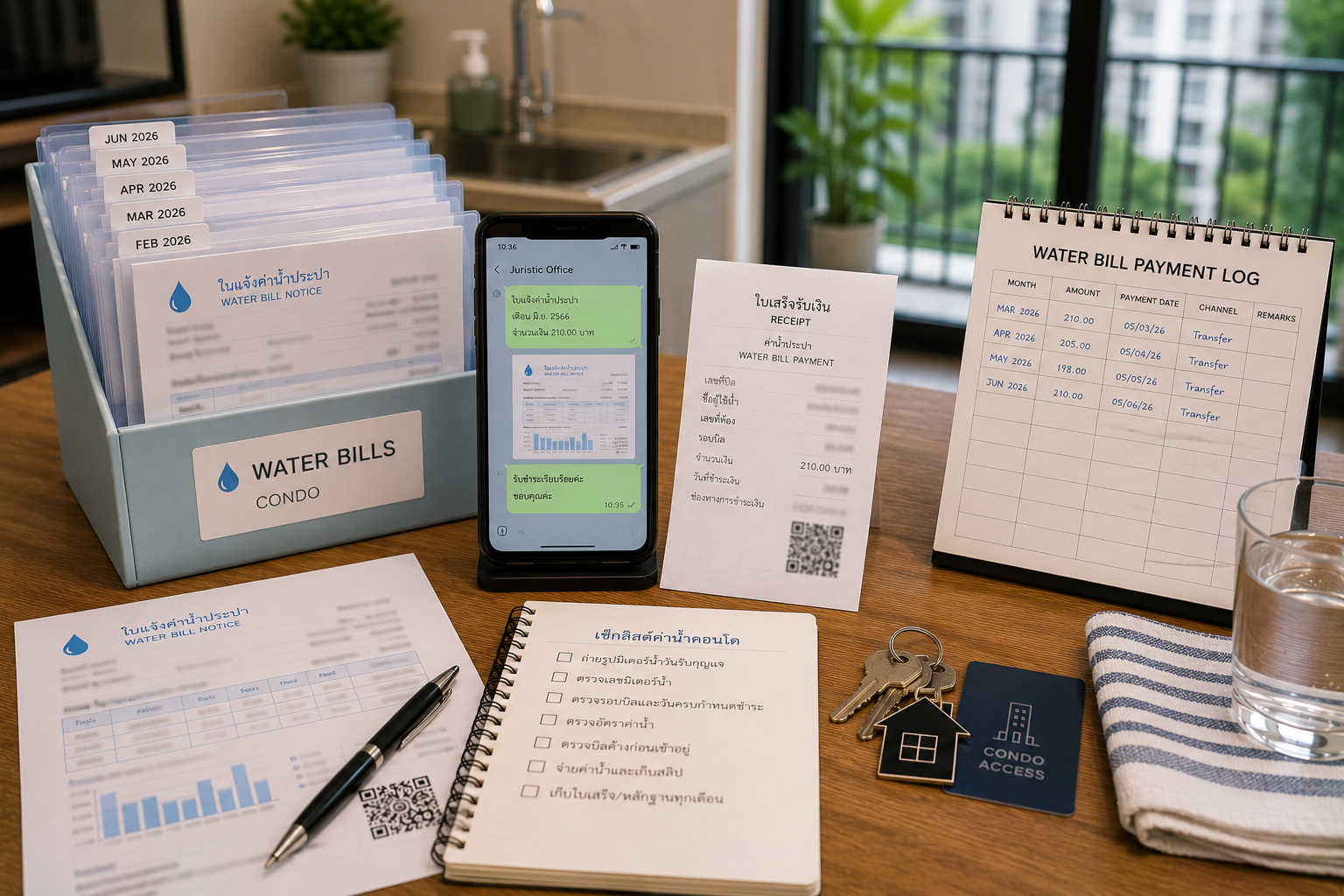
Keep water-payment evidence every month, just as you would for electricity. It may be needed to check outstanding balances when moving out or when the security deposit is returned. Evidence is especially important when payment is made through the owner or juristic office.
- Keep a photograph of the water bill.
- Keep the transfer slip.
- Keep the receipt or acknowledgement.
- Keep the chat confirming receipt of payment.
- Name files by month, such as water-july-2026.
- Back up files in the cloud or by email.
If a dispute arises over a bill or service, users can review information from the OCPB, Thailand's consumer-protection authority. However, any particular dispute should be considered in light of the relevant contract, evidence, and facts. :contentReference[oaicite:3]{index=3}
English summary: Keep water bills, receipts, transfer slips, and landlord or juristic office confirmations every month.
12. How Are Water Charges Related to the Security Deposit?
When a tenant moves out, the owner or landlord may check for outstanding water charges before returning the security deposit. The tenant should therefore photograph the water meter on move-out day and keep complete proof of the final month's payment.
- Photograph the water meter on move-out day.
- Check the final water bill.
- Agree who will pay the final bill.
- Keep the final month's payment slip or receipt.
- If possible, request written confirmation that no bills are outstanding.
- Keep the evidence until the security deposit has been returned in full.
If money is deducted from the security deposit for outstanding water charges, ask to see the bill or calculation before accepting the deduction. Do not accept a deduction that lacks clear details.
13. Condo Water-Bill Checklist for Thailand
- Check whether water is paid through the juristic office, owner, or MWA/PWA.
- Photograph the water meter when receiving the keys.
- Check whether charges use the unit meter or a shared system.
- Ask about the water rate per unit and any other fees.
- Check the billing cycle and due date.
- Check for outstanding bills before move-in.
- Ask for the actual bill if paying through the owner.
- Keep payment slips, receipts, and confirmation chats every month.
- Check for leaks if the water charge is unusually high.
- Notify the juristic office or water authority if there is no water or low pressure.
- Photograph the water meter on move-out day.
Conclusion
Condo water charges in Thailand should be checked from the day the keys are received. Start by photographing the water meter, ask how the water charge is calculated, check whether payment goes through the juristic office, unit owner, or water authority, check for outstanding bills before move-in, and keep proof of every monthly payment. If the water charge is unusually high, check for leaks, the toilet, taps, washing machine, and billing period before deciding on the cause.
For a rented unit, the tenant should ask the owner or landlord to confirm the meter reading and calculation method in writing. If payment is made through the owner, ask to see the actual bill every month. Baandeego is only a real estate listing platform and is not involved in collecting water charges, paying bills, or disputes between users.
English summary: For condo water bills, confirm the billing method, meter readings, payment channel, unpaid bills, and monthly proof before problems arise.
FAQ
1. Who Receives Condo Water Payments in Thailand?
It depends on the project and contract. Some condominiums collect payment through the juristic office, some units through the owner, and in some cases payment may be made directly to the MWA or PWA. Ask the juristic office and unit owner before paying.
English: It depends on the condo and contract. Payment may be through the juristic office, landlord, MWA, or PWA.
2. Should I Photograph the Water Meter When Receiving the Keys?
Always take a photograph, especially for a rented unit. The first day's meter reading confirms the starting point for water usage and makes it easier to separate charges incurred before and after move-in.
English: Yes. Move-in meter photos help confirm your starting water usage.
3. What Should I Do If the Water Charge Is Unusually High?
First check the taps, toilet, area under the sink, washing machine, drains, and billing period. Then notify the owner or juristic office with photographs and video. If the problem is outside the building, the appropriate local water authority may need to be contacted.
English: Check leaks, toilet, sink, washer, billing period, then report with evidence.
Platform Use Disclaimer
This website is only a real estate listing platform.
Users should verify information, documents, and conditions by themselves.
This website is only a real estate listing platform.
Users should verify information, documents, and conditions by themselves.
Baandeego is not a broker and is not a party to any rental, purchase and sale, booking, payment, contract, ownership transfer, water-bill payment, meter inspection, MWA/PWA contact, water-system repair, or coordination on behalf of users. It is not responsible for disputes between users, buyers, tenants, owners, sellers, landlords, service providers, juristic persons, or relevant authorities. All parties should independently verify the information, documents, conditions, costs, and applicable laws before making a decision.
References / Sources
- Metropolitan Waterworks Authority: https://www.mwa.co.th/en/
- MWA e-Service: https://eservicesapp.mwa.co.th/
- Provincial Waterworks Authority: https://en.pwa.co.th/
- PWA e-Service: https://en.pwa.co.th/contents/eservice
- PWA Payment: https://payment.pwa.co.th/
- Office of the Consumer Protection Board, Thailand: https://www.ocpb.go.th/index_en.php