Condo Electricity Bills in Thailand: How to Pay and What to Check
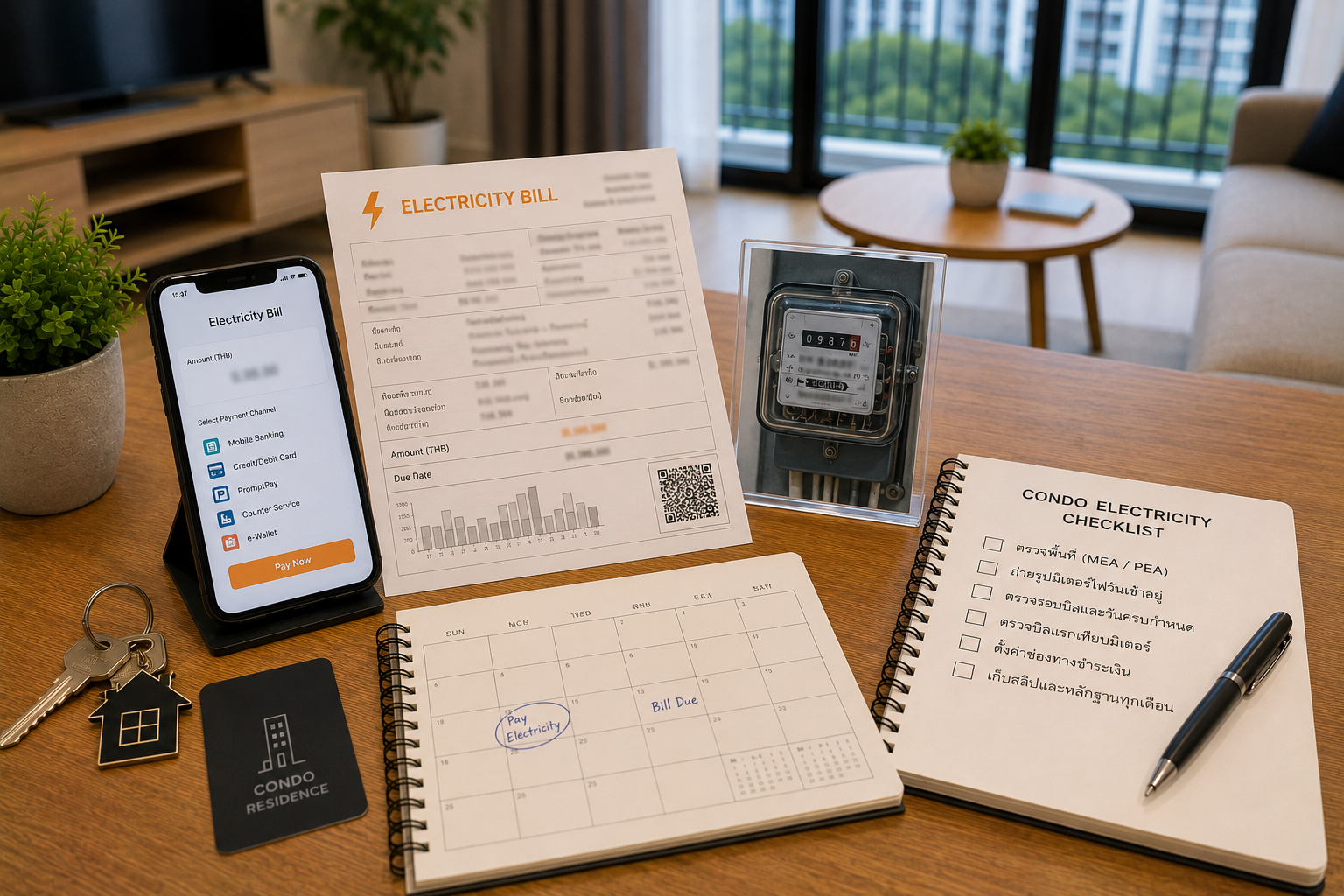
Condo electricity bills in Thailand are an expense that tenants and owners should clarify from the first day they move in. Depending on the area, building, and terms of the contract, electricity may be paid directly to an electricity authority, through the unit owner, or through the juristic office. If the meter reading, billing cycle, and payment channel are not checked, problems may arise, such as an unusually high first bill, duplicate payment, payment to the wrong account, or charges for electricity used before move-in.
This article explains how to check condo electricity bills in Thailand for people who have just moved into a rented unit, purchased a condominium, or rented directly from an owner. It focuses on checking the electricity meter, paying MEA or PEA bills, paying through the owner, checking the first bill, keeping payment slips, and precautions when electricity charges are unusually high.
English summary: Condo electricity bills in Thailand may be paid directly to MEA/PEA, through the landlord, or through the juristic office. Always check meter readings, billing cycle, payment channel, and proof.
1. Before Paying, Find Out Whether You Are in an MEA or PEA Service Area
The first thing to determine is which electricity authority serves your condominium. In general, the MEA serves Bangkok, Nonthaburi, and Samut Prakan, while the PEA serves many provincial areas, such as Chonburi, Pattaya, Phuket, Chiang Mai, Hua Hin, Rayong, and other provinces. Residents should ask the juristic office or unit owner directly before setting up electricity payments.
- Is the condominium in an MEA or PEA service area?
- Is the electricity bill issued directly by the authority?
- Is the bill in the owner's, tenant's, or juristic person's name?
- Which electricity-user number or account number is needed for payment?
- Were any bills outstanding before move-in?
- Is payment made through an app, website, bank, owner, or juristic office?
The MEA provides online services for checking and paying electricity bills. The PEA provides several payment channels and the PEA Smart Plus app for electricity users in its service areas. Always check the latest payment channels on the official website before paying.
English summary: First confirm whether your condo is under MEA or PEA service area, then check who receives the bill and how payment should be made.
2. Photograph the Electricity Meter When You Receive the Keys
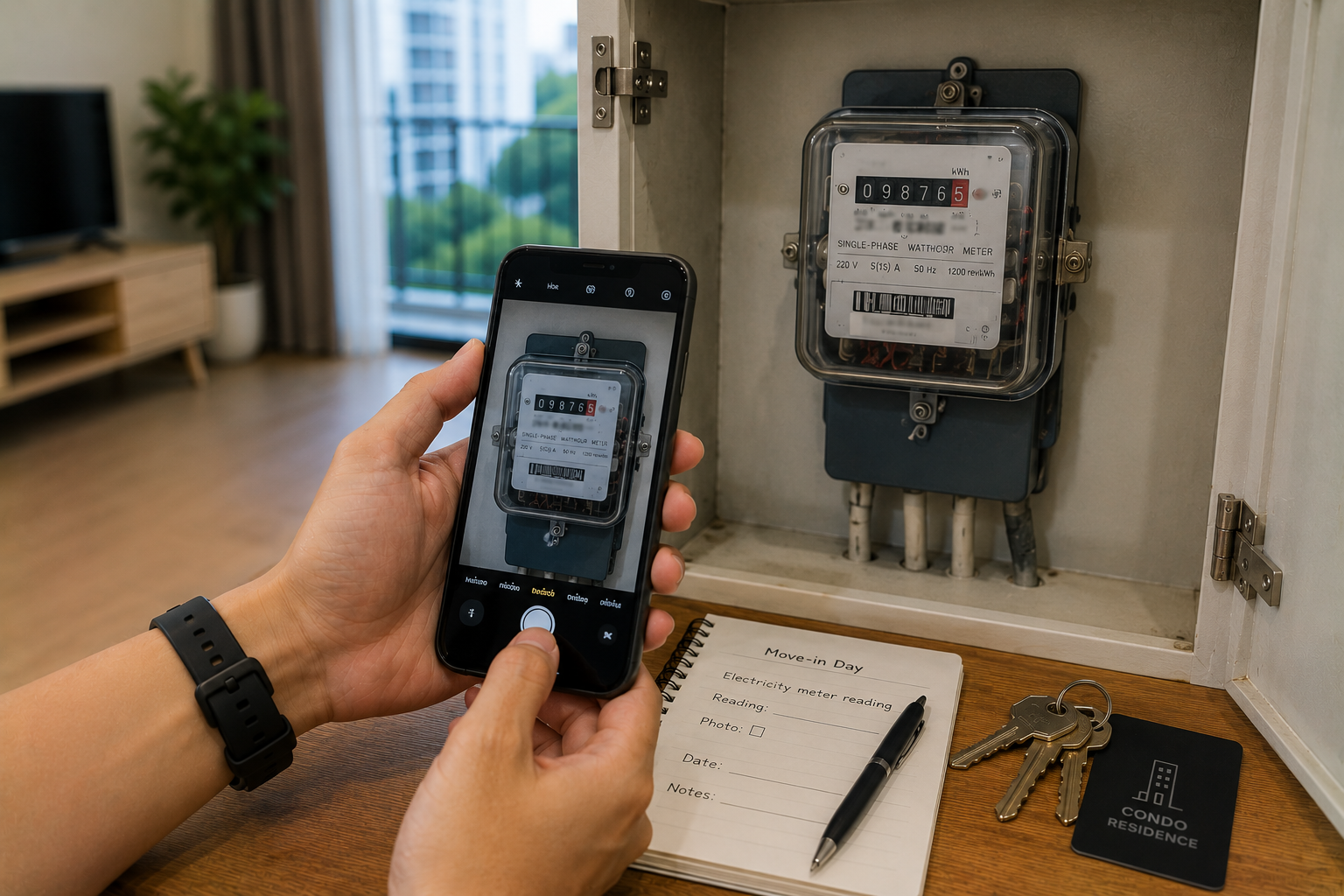
The first day's electricity-meter reading is very important evidence, especially for a rented unit. It helps separate electricity used before move-in from electricity used after the tenant begins occupying the unit. Take a clear photograph of the meter and send it to the owner or landlord that same day.
- Photograph the meter with every digit visible.
- Take the photograph when receiving the keys or moving in.
- Send the photograph to the unit owner in chat.
- Ask the owner to confirm the starting reading.
- Keep the photograph in the rental-document folder.
- Use it to compare against the first electricity bill after move-in.
If the meter is in a shared building room or an area the tenant cannot access, ask the juristic office or owner to confirm the meter reading in writing.
3. Check Whether Electricity Is Paid Directly or Through the Owner
Some condominium tenants pay electricity bills directly to the electricity authority, while in other units the owner receives the bill and collects payment from the tenant. Each payment method requires different checks.
- For direct payment, you should have an electricity-user number or verifiable bill details.
- For payment through the owner, ask to see the actual bill every month.
- Ask whose account receives the transfer and who must receive the payment slip.
- Always specify the month and billing period when transferring payment.
- Keep the chat in which the owner confirms receipt of payment.
- Do not pay electricity charges without bill details.
If the lease states that electricity is charged according to the actual bill, the tenant should ask to see the actual bill or verifiable evidence before every payment. If the lease specifies a particular electricity rate, ensure that rate is clear before signing.
English summary: If paying through the landlord, ask for the actual bill and keep transfer slips and written confirmation every month.
4. Check the Billing Cycle and Payment Due Date
The electricity bill is not always issued on the same date as the rent. Ask about the billing cycle and payment due date from the first month. Late payment may result in a penalty or a risk of service suspension under the provider's or building's conditions.
- On what dates does the electricity billing cycle begin and end?
- Approximately what day of the month is the bill issued?
- What is the payment due date?
- Is there a penalty for late payment?
- If paying through the owner, by what date must the slip be sent?
- Should a reminder be set on a phone or calendar?
Billing reminders help prevent missed payments, especially for people managing several costs after move-in, such as rent, water, internet, parking, and common-area fees.
5. How to Pay an MEA Electricity Bill for a Condo in Bangkok, Nonthaburi, or Samut Prakan
If the condominium is in an MEA service area, users can check the MEA's online services, such as MEA Smart Service, MEA ePayment, MEA eBill, or the MEA Smart Life App, based on official MEA information. Actual use may require the correct electricity-user number or bill details.
- Check electricity charges through MEA online services.
- Pay through a channel supported by the MEA.
- Register for eBill or e-Receipt if appropriate.
- Keep payment evidence and receipts.
- Check that the electricity-account name and unit address are correct.
- If paying through the owner, ask to see the actual MEA bill.
The MEA states that its online services can be used to check and pay electricity bills, receive notifications, and manage accounts. Users should use official MEA channels to avoid paying through the wrong channel.
English summary: For Bangkok, Nonthaburi, and Samut Prakan, check official MEA channels such as MEA Smart Service, ePayment, eBill, or Smart Life App.
6. How to Pay a PEA Electricity Bill for a Condo in a Provincial Area
If the condominium is in a PEA service area, users should check payment channels on the PEA's official website or app. According to official PEA information, the PEA offers several payment methods, such as PEA e-Pay, mobile applications, the website, payment agents, and the PEA Smart Plus App.
- Check that the electricity-user number or bill details are correct.
- Pay through an official PEA channel or an authorised channel.
- Check any payment-channel fee.
- Keep the receipt or payment evidence.
- Review bill history or previous amounts if anything is unclear.
- If paying through the owner, ask to see the actual PEA bill.
The PEA states that some payment channels may charge fees set by their agents. Users should read the details before paying.
7. Check the First Bill After Moving In Carefully
The first electricity bill requires the closest review because it may include a period before move-in or a time when the owner used the unit before handover. Without the first day's meter reading, separating the charges may be difficult.
- From which date is the first bill calculated?
- Does the opening meter reading match the photograph taken when the keys were received?
- Does it include electricity used before the lease began?
- Is the increase in electricity units reasonable?
- Are there any fees or other charges?
- Who is responsible for the amount incurred before move-in?
If the first bill appears unusually high, immediately notify the owner or juristic office and attach the first-day meter photograph, the bill, and the lease showing the start date.
English summary: Check the first electricity bill carefully against your move-in meter photo and lease start date.
8. What to Check First If the Electricity Bill Is Unusually High
An unusually high electricity bill may have several causes, such as prolonged air-conditioner use, hot outdoor temperatures, an old air conditioner, a refrigerator working heavily, frequent water-heater use, power-hungry extension leads or appliances, or a longer billing period than usual. Do not immediately conclude that the meter is faulty or that the owner calculated the bill incorrectly.
- Compare the number of electricity units with the previous month.
- Check whether the billing period is longer than usual.
- Check the hours of air-conditioner use.
- Check the refrigerator, water heater, washing machine, and microwave.
- Check whether the air conditioner drips, does not cool, or works unusually hard.
- Check whether a bill from before move-in is included.
The MEA provides electricity-saving guidance, such as turning off unused lights, setting the air conditioner to about 26-27 degrees, using a fan as well, unplugging devices when not in use, choosing energy-efficient equipment, and cleaning the air conditioner as appropriate. These measures may reduce electricity use. Actual charges depend on the condition of the unit, its appliances, and each person's usage.
9. Who Should Be Contacted If There Is an Outage, Voltage Drop, or Outlet Problem?
If the whole unit loses power, the voltage drops, an outlet becomes hot, there is a burning smell, or the circuit breaker trips frequently, put safety first. Do not attempt repairs without electrical knowledge, and determine whether the problem affects only your unit or the entire building.
- If the entire building loses power, notify the juristic office or security staff.
- If only the unit loses power, first notify the owner or juristic office.
- If an outlet smells burnt or becomes unusually hot, stop using it immediately.
- If the circuit breaker trips frequently, have a technician inspect it.
- If the problem is outside the building, the MEA or PEA for the area may need to be contacted.
- Keep photographs, video, and the time of the incident.
For a rented unit, always agree with the owner before electrical repairs because they may involve the lease, repair costs, and liability for damage.
English summary: For power outage or electrical safety issues, contact the juristic office, landlord, or MEA/PEA depending on whether the problem is inside the unit or external.
10. Keep Proof of Every Monthly Electricity Payment

Organise electricity-payment evidence every month, especially for a rented unit where payment is made through the owner. It may be needed when moving out, receiving the security deposit, or resolving a dispute over outstanding bills.
- Keep a photograph of the electricity bill.
- Keep the transfer slip.
- Keep the receipt or e-Receipt.
- Keep the chat in which the owner confirms receipt.
- Name files by month, such as electricity-july-2026.
- Back up files in the cloud or by email.
If paying through an app or website, download the receipt or take a screenshot confirming payment, while taking care not to publish personal information or account numbers.
11. What Should You Watch for When Paying Electricity Through the Owner?
Paying electricity through the unit owner is not necessarily improper, but the actual bill, amount, billing period, and payment evidence must be clear. Tenants should not transfer a stated amount without a photograph of the bill or supporting details.
- Ask to see the actual bill every month.
- Check that the bill is for your unit.
- Check the billing period and number of electricity units.
- Specify the month and charge on the transfer slip.
- Ask the owner to confirm receipt of payment in writing.
- Keep the evidence until moving out and fully settling the account.
If the owner charges an electricity amount that does not match the lease or refuses to show the bill details, request a written explanation and keep all evidence.
English summary: When paying electricity through the landlord, ask for the real bill, confirm the room and billing period, and keep written proof.
12. How Are Electricity Charges Related to the Security Deposit?
When a tenant moves out, the owner may check for outstanding water and electricity bills before returning the security deposit. The tenant should therefore keep monthly electricity-payment evidence and photograph the meter on move-out day to confirm the final amount.
- Photograph the electricity meter on move-out day.
- Check the final bill or outstanding balance.
- Agree who will pay the final bill.
- Keep the final month's electricity payment slip.
- If possible, request written confirmation that no bill is outstanding.
- Keep the evidence until the security deposit has been returned in full.
If money is deducted from the security deposit for unpaid electricity, ask to see the bill or outstanding-balance calculation before accepting the deduction.
13. Condo Electricity-Bill Checklist for Thailand
- Check whether the condominium is in an MEA or PEA service area.
- Photograph the electricity meter when receiving the keys.
- Ask whether electricity is paid directly or through the owner.
- Check the billing cycle and payment due date.
- Set up an official payment channel.
- Compare the first bill with the move-in meter reading.
- Investigate the cause if the bill is unusually high.
- Notify the owner or juristic office if there is an electricity problem.
- Keep bills, payment slips, and receipts every month.
- Photograph the meter on move-out day.
Conclusion
Managing condo electricity bills in Thailand should begin by checking whether the property is in an MEA or PEA service area, photographing the electricity meter on the first day, asking how payment is made, checking the billing cycle, and keeping proof of every monthly payment. If electricity is paid through the unit owner, the tenant should ask to see the actual bill and always keep the owner's chat confirming receipt.
If the electricity bill is unusually high, check the number of units, billing period, air-conditioner use, appliances, and any bill from before move-in before deciding on the cause. For an electrical or safety problem, notify the owner, juristic office, or electricity authority responsible for the area, and do not attempt repairs without the necessary knowledge.
English summary: Check MEA/PEA area, photograph your meter, confirm payment method, review the first bill, and keep proof of every electricity payment.
FAQ
1. Must Condo Electricity in Thailand Always Be Paid to the MEA or PEA?
Not always. Some tenants pay the MEA or PEA directly, while others pay through the unit owner or juristic office. This depends on the contract and the building's system. Check the documents and ask to see the actual bill before paying.
English: Not always. Some tenants pay MEA/PEA directly, while others pay through the landlord or juristic office.
2. What Should I Do If the First Electricity Bill Is Unusually High?
Compare it with the move-in meter photograph, check the billing period, determine whether it includes electricity used before move-in, and notify the owner or juristic office with evidence. If paying the electricity authority directly, check the details through an official channel.
English: Compare it with your move-in meter photo and check whether the bill includes usage before your lease started.
3. What Evidence Should I Keep If Paying Electricity Through the Owner?
Keep a photograph of the actual bill, the transfer slip, the chat stating the amount, the owner's confirmation of receipt, and a receipt if available. Name files by month so they are easy to find when moving out or if a dispute arises.
English: Keep the actual bill, transfer slip, landlord chat confirmation, and receipt if available.
Platform Use Disclaimer
This website is only a real estate listing platform.
Users should verify information, documents, and conditions by themselves.
This website is only a real estate listing platform.
Users should verify information, documents, and conditions by themselves.
Baandeego is not a broker and is not a party to any rental, purchase and sale, booking, payment, contract, ownership transfer, electricity-bill payment, meter inspection, MEA/PEA contact, electrical-system repair, or coordination on behalf of users. It is not responsible for disputes between users, buyers, tenants, owners, sellers, landlords, service providers, juristic persons, or relevant authorities. All parties should independently verify the information, documents, conditions, costs, and applicable laws before making a decision.
References / Sources
- Metropolitan Electricity Authority — Check/Pay Electricity Bills Online with MEA Smart Service: https://www.mea.or.th/en/our-services/mea-service/check-pay
- Metropolitan Electricity Authority — MEA ePayment: https://www.mea.or.th/en/our-services/mea-service/e-service/mea-ePayment
- Metropolitan Electricity Authority — MEA eBill: https://www.mea.or.th/en/our-services/mea-service/e-service/mea-eBill
- Metropolitan Electricity Authority — Electricity Saving Tips: https://www.mea.or.th/en/electricity/energy-saving-tips/
- Provincial Electricity Authority — Payment Channel: https://www.pea.co.th/en/our-services/payment-channel
- Provincial Electricity Authority — PEA Mobile Application: https://www.pea.co.th/en/our-services/mobile-apps
- Office of the Consumer Protection Board, Thailand: https://www.ocpb.go.th/index_en.php