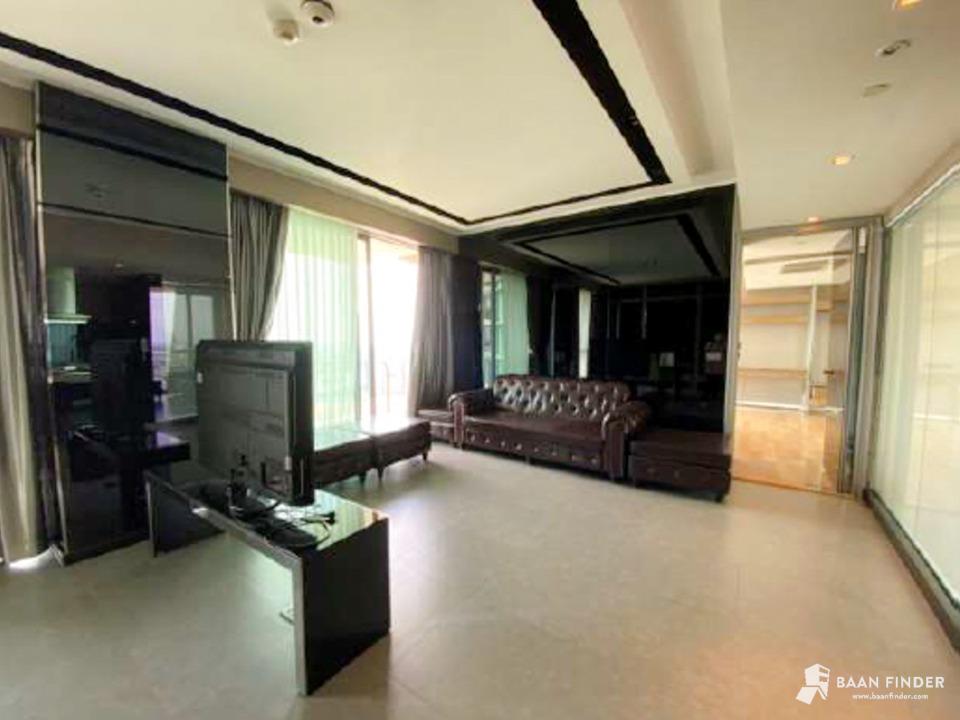
Renting a Condo Near a University in Bangkok: What Should Students Check?
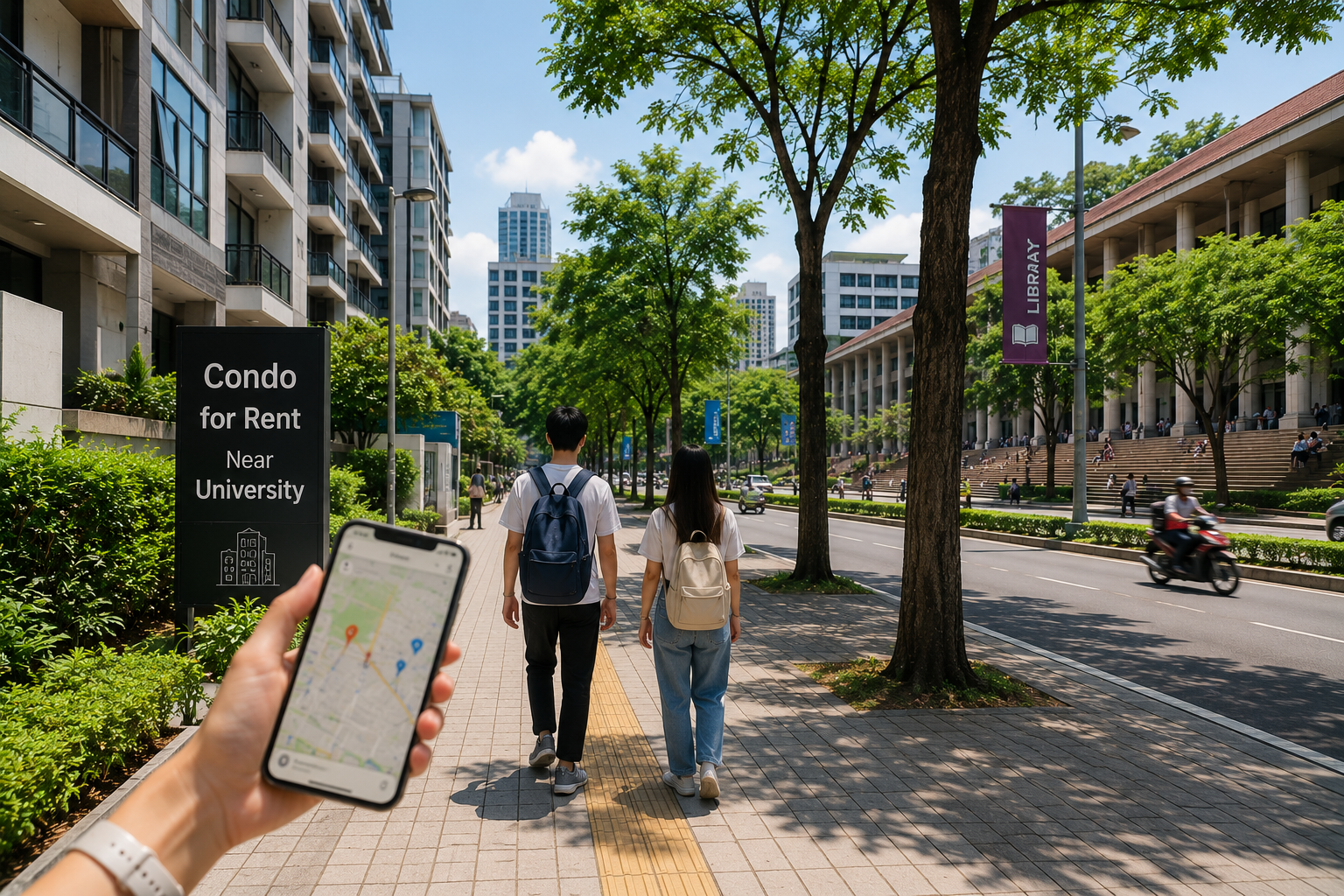
Renting a condo near a university in Bangkok is an option that interests students, parents, international students, and people who study or work near an educational institution because it can reduce travel time and make daily life more convenient. However, choosing a student condo should not be based only on whether it is \"near the university\" or \"cheap.\" Check the actual journey, safety, total costs, internet, study space, building rules, and contract terms before deciding.
Bangkok has many universities in both central and outlying areas, including Chulalongkorn University, Thammasat University, Mahidol University, Kasetsart University, Bangkok University, and other institutions. Each area is different. Some are near the BTS or MRT, while others require a bus, boat, van, or motorcycle taxi as part of the journey. Tenants should check the actual route from the condo to their faculty or teaching building rather than looking only at the distance on a map.
English summary: Students renting a condo near a university in Bangkok should check real commute time, safety, total cost, internet, study space, building rules, and contract terms before paying.
1. First, Confirm Which Campus You Will Attend
Some universities have several campuses or faculties in different locations. Students should confirm which building and campus they will attend and how many times a day they will have classes, because a condo that is close to the university in name may not actually be close to their faculty or teaching building.
- Confirm the campus where you will actually study
- Check the main teaching buildings and the faculty you will visit frequently
- Find out whether you have early classes, evening classes, or activities after class
- Check the route from the condo to the faculty entrance, not only to the university entrance
- Ask senior students or the international student office if you are unsure about the area
For example, some universities have both central Bangkok locations and outlying campuses. Tenants should therefore check the university's official website and ask their faculty or program directly.
English summary: Check your exact campus and faculty location before renting, because one university may have multiple campuses or buildings.
2. Measure the Distance from the Condo to the Classroom
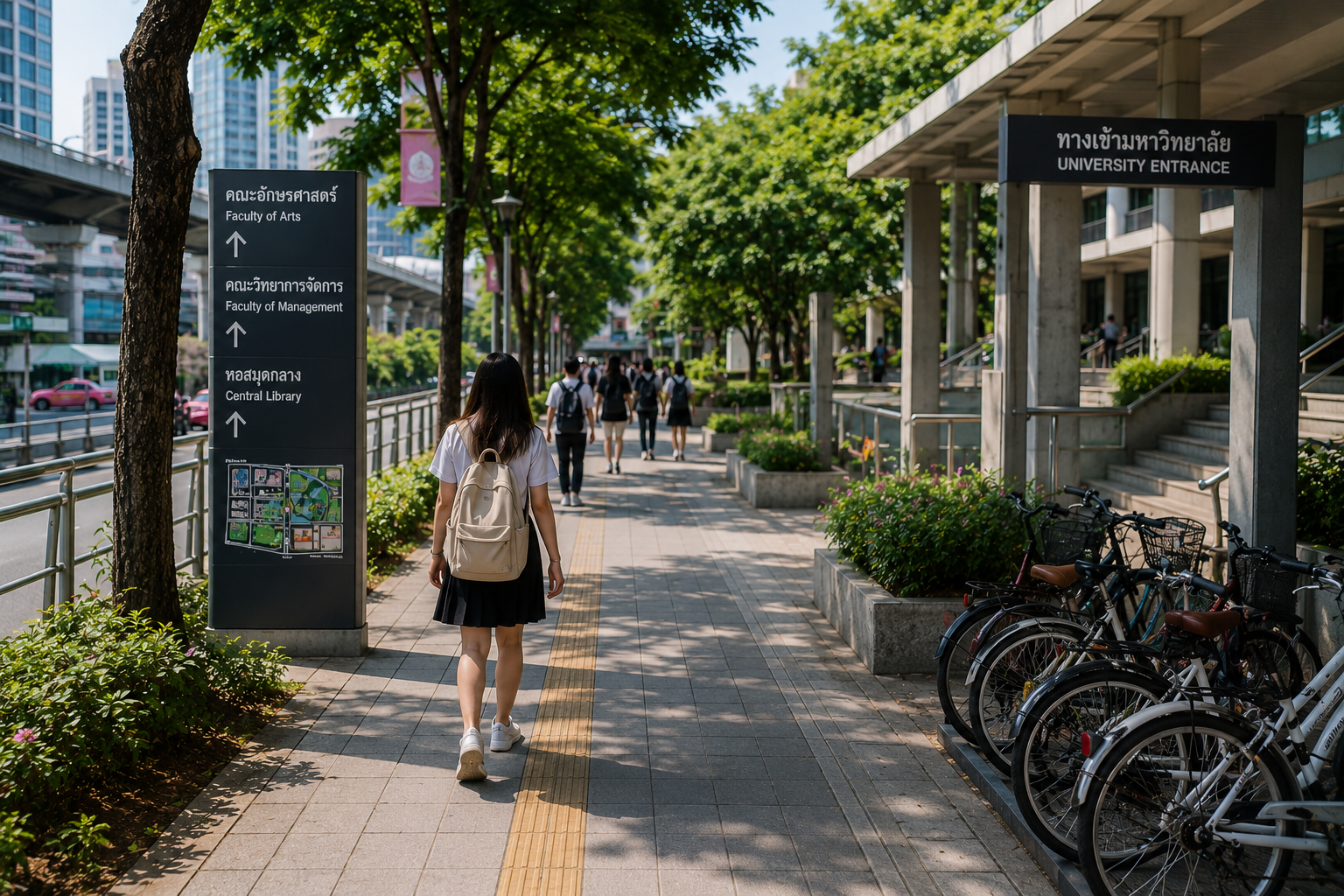
The phrase \"near the university\" may mean close to the campus boundary, but in practice a student may still need to walk a long way to their teaching building, laboratory, library, or faculty. Calculate the actual time from the condo to the classroom.
- How many minutes does it take to walk from the condo to the university entrance?
- How much longer does it take to reach the faculty or teaching building from the entrance?
- Is there a shuttle service within the university?
- Is the route still convenient in rain or strong sun?
- Does the journey take a different amount of time in the morning and evening?
- Is this route still suitable if you have an 8 a.m. class?
If you study in several buildings or regularly use laboratories, libraries, and activity areas, choose a condo with easy access to the university's main routes rather than relying only on map distance.
3. Compare a Condo with Student Accommodation
Before choosing a condo, compare it with student accommodation or university housing, as each option has different advantages. Student accommodation may be closer to the faculty and make costs easier to control, while a condo may offer more privacy and facilities but have higher total costs.
- Is student accommodation closer to the faculty?
- Does the condo offer more privacy?
- Are water, electricity, and internet included or paid separately?
- Is there a fitness center, swimming pool, or study area?
- Are there restrictions on entry times or guests?
- How much do the total monthly budgets differ?
First-year or international students who are not yet familiar with Bangkok may wish to start with accommodation that is easy to reach and has a clear support system, then move to a condo in a later year if they want more privacy.
English summary: Compare university dorms and condos by distance, privacy, total cost, facilities, rules, and support system.
4. Check the Safety of the Route Home
Some students finish classes late, attend activities, or study at the library until late at night, so the route from the university back to the condo is very important. Check whether the route is adequately lit, whether other people use it, and whether it is easy to call a vehicle.
- Is the route from the university to the condo adequately lit?
- Are there shops, restaurants, or other people along the route in the evening?
- Is there a nearby bus stop, pick-up point, or motorcycle taxi stand?
- Can you still get home conveniently if it rains or classes end late?
- Does the condo entrance have security staff, CCTV, and a key-card system?
- If possible, parents should inspect the actual route before deciding
Check route safety both during the day and at night, because an area that looks convenient during the day may become very quiet after shops close or normal class hours end.
5. Total Monthly Cost Matters More Than Rent Alone
Students and parents should calculate the total monthly cost rather than looking only at rent, because a condo may also have electricity, water, internet, laundry, transport, parking, or building access card costs.
- Monthly rent
- Water, electricity, and internet
- Daily travel to the university
- Food and convenience store expenses around the condo
- Laundry service or coin-operated washing machines
- Parking or a parking card, if you have a vehicle
- The deposit and advance rent due when the contract begins
Sometimes a condo with lower rent but a more distant location may cost more to reach and take more time. Compare the total cost with the actual convenience before choosing.
English summary: Students should calculate total monthly cost, including rent, utilities, internet, transport, laundry, parking, and upfront deposit.
6. Internet Must Support Online Classes and Group Work
Internet is essential for students to attend online classes, submit assignments, prepare reports, join group meetings, and take certain exams. Ask whether the unit already has internet or the tenant must arrange a subscription, and test the mobile signal inside the unit as well.
- Is internet included in the rent?
- Is the internet speed suitable for online classes?
- If you must subscribe yourself, which providers serve the building?
- Are there installation fees, equipment costs, or a minimum contract term?
- Is the mobile signal reliable in the unit and study areas?
- Is Wi-Fi available in the common areas?
If you will attend online classes frequently, test a video call or the internet speed before signing a long-term contract, or ask the unit owner to confirm the internet terms in the chat or contract.
7. Look at the Study Space and Room Environment
A student condo should have a genuinely usable study area, not only an attractive room. If the unit is very small, has no desk, or is noisy, it may affect studying and rest over the long term.
- Is there a study desk or workspace?
- Is there enough natural light?
- Is there loud noise from the road, restaurants, or neighbors?
- Are there enough power outlets for a laptop and study equipment?
- Is the study chair suitable for long periods of use?
- Is there a reading room or co-working space in the building?
If you need to study intensively or work on projects often, give lighting, noise, the desk, and internet as much consideration as the bed and the view.
English summary: A student condo should support studying: desk space, lighting, quietness, power outlets, internet, and common study areas.
8. Check Restaurants, Laundry, and Daily Essentials
Student life frequently depends on nearby services such as affordable restaurants, convenience stores, laundries, copy shops, pharmacies, cafes, and stationery shops. A condo close to these services can substantially reduce travel costs and save time.
- Are there student-priced restaurants near the condo?
- Is there a convenience store within walking distance?
- Is there a washing machine, laundromat, or laundry service nearby?
- Is there a copy or printing shop near the university?
- Is there a nearby pharmacy, clinic, or hospital if needed?
- Is there a genuinely usable study area or cafe?
A condo near a university but without basic services nearby may be less convenient than expected, especially for students without a private vehicle.
9. If You Have a Roommate, Agree on the Terms Clearly
Many students choose to share a condo with a friend to split the rent, but they should agree on costs, responsibilities, and whose name appears in the contract from the outset. If someone moves out early or does not pay on time, problems may follow.
- Whose name is listed as the tenant in the contract?
- How will rent, water, electricity, and internet be divided?
- Who will transfer the money to the unit owner?
- Who owns the deposit, and how will it be returned?
- If a roommate moves out early, how will the costs be handled?
- What are the room rules for guests, noise, cleaning, and shared items?
Keep proof of every transfer between roommates and the unit owner so it can be reviewed if there is a later disagreement.
English summary: If sharing a condo with roommates, clarify the lease name, rent split, deposit, bills, early move-out, guests, and cleaning duties.
10. Ask a Parent or Qualified Person to Help Review the Lease
Some students may be renting a condo for the first time, so they should read the contract carefully. If they are unsure, they should ask a parent or experienced person to help review it, especially the terms covering the deposit, advance rent, moving out before the contract ends, and costs that may be deducted when the unit is returned.
- How many months is the contract term?
- How much are the deposit and advance rent?
- What are the terms if you move out before the contract ends?
- Who is responsible for repairs?
- Must the air conditioner be cleaned or the unit cleaned before it is returned?
- When and how will the security deposit be refunded?
If users have questions about payments or the contract, they can check information from the Office of the Consumer Protection Board and should consider the contract and evidence in each individual case.
11. Verify the Landlord and Receiving Account Before Transferring Money
Before transferring a deposit or advance rent, check whether the landlord is the unit owner or a person genuinely entitled to rent it out. Check the receiving account name and request proof of receipt every time. Do not transfer money solely because the unit looks good or someone says you must hurry to book it.
- View the actual unit or have a live video call before transferring money
- Check the landlord's name and receiving account
- Read the contract before paying a large amount
- State what the transferred money is for, such as a deposit or advance rent
- Request a receipt or written confirmation
- Keep the transfer slip and chat until you have moved out and all balances are settled
International students should be particularly cautious if they are not yet in Thailand and have not viewed the actual unit. Ask someone you trust to inspect it or request a live video call from the front of the condo, lobby, corridor, and inside the unit.
English summary: Before paying, verify the landlord, bank account, contract, room condition, and receipt. International students should be especially careful if renting remotely.
12. Checklist for Renting a Condo Near a University in Bangkok

- Confirm the actual campus and teaching building
- Measure the distance from the condo to the classroom, not only the campus boundary
- Compare a condo with student accommodation
- Check the route home at night
- Calculate the total monthly cost
- Check internet and the mobile signal
- Assess the study space and how quiet the unit is
- Check nearby restaurants, laundries, pharmacies, and services
- Agree clearly on terms with roommates
- Read the lease and deposit terms
- Verify the landlord and receiving account before transferring money
Conclusion
When renting a condo near a university in Bangkok, choose according to the student's actual daily life rather than only the university name or the word \"nearby.\" Before paying, check the campus, teaching building, journey, safety, total costs, internet, study space, nearby shops, roommates, and lease.
When renting directly from an owner, view the actual unit, verify the landlord's identity, check the receiving account, and keep evidence at every stage. Baandeego is only a real estate listing platform. It is not involved in bookings, payments, contracts, unit inspections, or verifying landlord information on behalf of users.
English summary: Student condo rentals should be chosen by real campus access, safety, total cost, internet, study environment, daily services, roommates, contract terms, and payment proof.
FAQ
1. Should Students Choose a Condo or University Accommodation?
It depends on the budget, distance, privacy, and support system. Student accommodation may be closer to the faculty and make costs easier to control, while a condo may offer more privacy and facilities. Calculate the total cost before choosing.
English: Dorms may be simpler and closer, while condos offer privacy and facilities. Compare total cost and daily convenience.
2. How Should You Measure the Distance When Renting a Condo Near a University?
Measure from the condo to the actual teaching building, not only to the campus boundary. Test the real walk or journey at the times you will use it, such as traveling to class in the morning and returning to the unit in the evening.
English: Measure the real route from the condo to your classroom or faculty building, not just the campus gate.
3. What Should You Check Before Transferring a Deposit for a Student Condo?
View the actual unit, check the landlord's name, verify the receiving account, read the contract, review all costs, and always keep transfer slips, receipts, or confirmation chats, especially when renting remotely.
English: View the room, verify the landlord and payment account, read the contract, check total costs, and keep proof.
Platform Use Disclaimer
This website is only a platform for real estate listings.
Users should verify all information, documents, and conditions themselves.
This website is only a real estate listing platform.
Users should verify information, documents, and conditions by themselves.
Baandeego is not a broker and is not a party to any rental, purchase, sale, booking, payment, contract, or ownership transfer. It does not inspect units, inspect documents, inspect locations, or verify landlord information on behalf of users. It is not responsible for disputes among users, buyers, tenants, owners, sellers, landlords, roommates, juristic persons, or relevant authorities. All parties should independently verify the information, documents, conditions, costs, location, and applicable laws before deciding.
References
- Chulalongkorn University — Map & Directions: https://www.chula.ac.th/en/about/contact/map-and-directions/
- Chulalongkorn University — Life in Bangkok: https://www.chula.ac.th/en/life-at-cu/life-in-bangkok/
- Thammasat University — Campus Life: https://oia.tu.ac.th/campus-life/
- Mahidol University — Life at Mahidol University: https://mahidol.ac.th/life/
- Office of the Consumer Protection Board, Thailand: https://www.ocpb.go.th/index_en.php