How to Transfer a Condo Rental Booking Payment in Thailand with Clear Evidence

Transferring a condo booking payment is a step many tenants encounter after viewing a listing, speaking with the owner, and arranging to see the room. Before transferring money, whether it is called a booking fee, deposit, advance rent, or security deposit, tenants should clearly check what the payment is for, who will receive it, whether it is refundable, and what evidence confirms it. Once money has been transferred, proving the terms later may be difficult without clear chats, transfer slips, receipts, or a lease.
This article is a general guide for condo tenants in Bangkok, Pattaya, Chonburi, Phuket, Chiang Mai, Hua Hin, and other areas of Thailand. It focuses on preparing evidence before transferring a condo booking payment, such as verifying the landlord and recipient account, requesting written confirmation, checking the lease, requesting a receipt, keeping the transfer slip, and saving chats. The Office of the Consumer Protection Board is Thailand's official consumer protection agency, and Thai Police Online is an official channel associated with online police reports and technology-crime services. Users should check information from official agencies when necessary.
English summary: Before paying a condo reservation deposit in Thailand, tenants should verify the landlord, bank account, payment purpose, refund terms, lease details, receipt, transfer slip, and written chat confirmation.
1. First Distinguish Between a Booking Fee, Security Deposit, and Advance Rent
Before transferring money, tenants should ask clearly what the payment is called, because booking fee, security deposit, and advance rent may have different meanings and terms depending on the agreement in each case. If it is not clearly identified, misunderstandings may arise later. For example, a tenant may think the booking fee is refundable, while the owner believes it will not be refunded if the tenant changes their mind.
- Is the booking fee a payment to hold the room temporarily?
- Is the security deposit intended to cover damage?
- Is the advance rent for the first or last month?
- Will this payment count toward the amount due on the lease-signing date?
- If the lease is not signed, is this payment refundable?
- Should the condo name, room number, and terms be stated in the chat or lease?
Always ask the landlord to state clearly in writing "what the transferred payment is for" and "in which cases it is refundable" before transferring money.
English summary: Clarify whether the payment is a booking fee, security deposit, or advance rent, and confirm refund conditions in writing.
2. Do Not Transfer Money Before Viewing the Actual Room or Having a Live Video Call
Viewing the actual room or having a live video call helps reduce the risk of a listing that does not match the room, old photos, or a person who has no right to rent it out. If you have not viewed the actual room, be cautious if you are pressured to transfer a booking payment on the claim that several people are interested or the room will be taken immediately.
- View the actual room before transferring money.
- If you are in another province or country, request a live video call.
- The live video call should show the front of the condo, lobby, corridor, room entrance, and interior.
- Ask the landlord to demonstrate the water, electricity, air conditioner, and some appliances.
- If the room cannot be viewed at all, check further before deciding.
Rushing to transfer money because you are afraid of losing the room may put you at a disadvantage if there is not enough evidence that the room exists and that the landlord genuinely has the right to rent it out.
3. Check Whether the Recipient Has the Right to Rent Out the Room or Receive the Money
Before transferring a condo booking payment, check whether the recipient is the owner, a person with the right to rent out the room, or a relevant authorized representative. If the name of the person who posted the listing, the landlord's name, the name in the lease, and the recipient-account name do not match, ask for the reason and additional evidence before transferring.
- Is the landlord the room's direct owner?
- If the person is an authorized representative, is there evidence from the owner?
- Does the recipient-account name match the landlord?
- Will the name in the lease match the recipient's name?
- Can the building's juristic office confirm the rental, as appropriate?
- If the information does not match, delay the transfer.
The Department of Lands is Thailand's official agency for real estate registration and information. If an ownership issue or real estate document requires official verification, check with the relevant agency or a professional.
English summary: Verify that the person receiving money has the right to rent out the unit or is properly authorized.
4. Check the Recipient-account Name Before Every Transfer
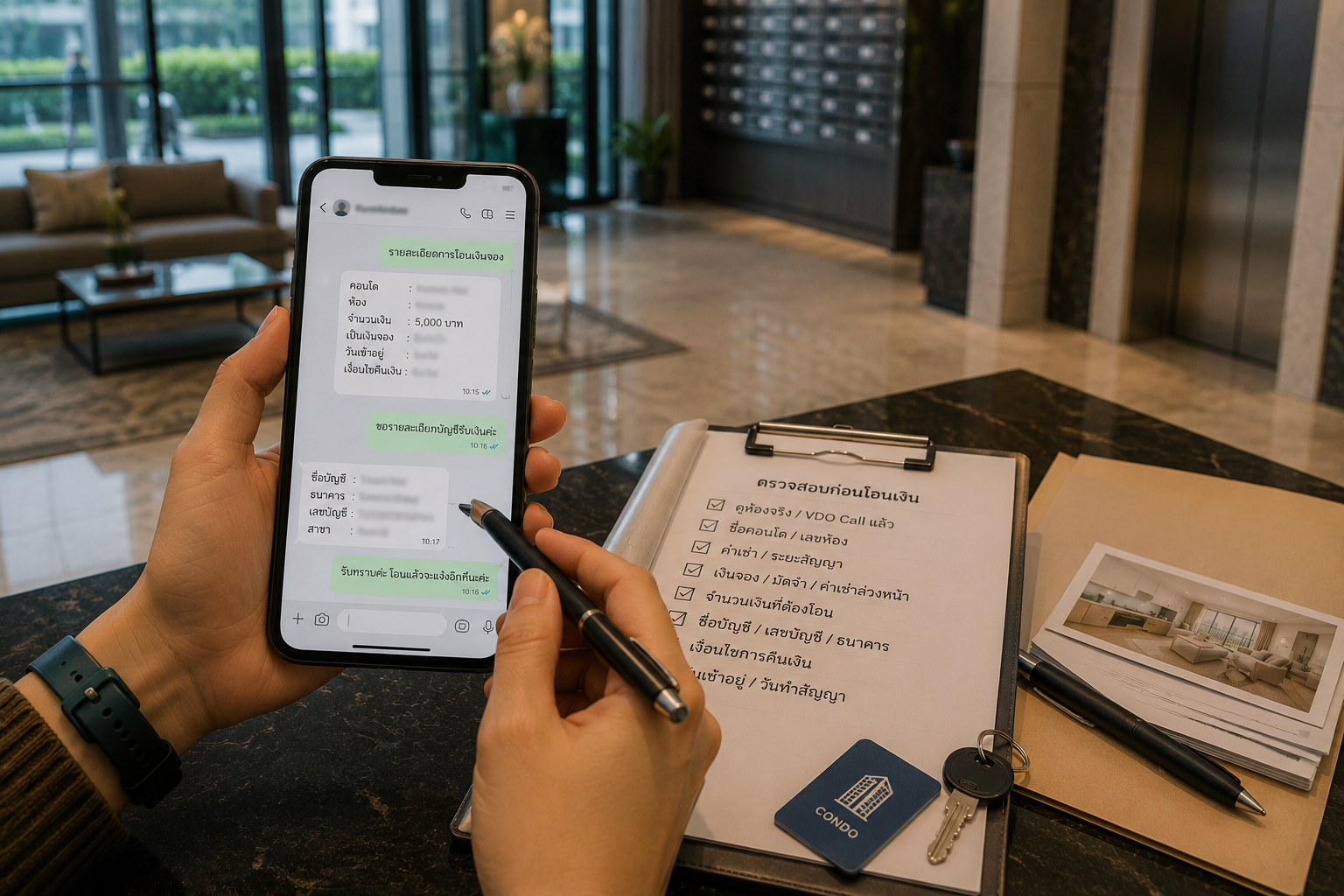
The recipient-account name is very important because it helps connect the payment to the landlord. If the landlord asks you to transfer money to someone else's account, such as that of a relative, friend, assistant, or a person whose name does not match the lease, ask clearly why. There should be written confirmation that the owner or landlord knows about and accepts that account as the recipient account.
- Does the account name match the landlord?
- Do the account number and bank match the details provided in the chat or document?
- Has the recipient account suddenly changed?
- Is the recipient account a personal or company account?
- Ask for confirmation of the account name, amount, and purpose before transferring.
- Do not transfer to an unrelated account without clear evidence.
If you have questions about the account or payment, stop and check further before transferring. Do not rush merely because you are pressured to decide immediately.
5. Request Written Confirmation Before Transferring Money
Before transferring money, ask the landlord to summarize the important terms in a chat or document so there is evidence that both parties have the same understanding. The message should be clear and contain enough detail for later checking.
- Condo name and room number.
- Amount to be transferred.
- Whether the payment is a booking fee, security deposit, or advance rent.
- Move-in date or lease-signing date.
- Monthly rent and lease term.
- Refund or non-refund terms.
- Account name, bank, and recipient name.
If the landlord refuses to summarize the terms in writing but asks you to transfer money first, be cautious and check further before deciding.
English summary: Before paying, ask the landlord to confirm unit details, payment purpose, amount, refund terms, bank account, and lease conditions in writing.
6. Use a Clear Transfer Note
When transferring money through a banking app, if there is a field for a note or memo, clearly state what the payment is for and which room it concerns, such as condo booking payment, project name, room number, or the relevant month. This gives the transfer slip more supporting information.
- State whether it is a booking fee or security deposit.
- State the condo name or room number if convenient and without disclosing more information than necessary.
- State the relevant month or date.
- Avoid transferring without any message if a note can be added.
- Check the amount and recipient name before confirming.
After transferring, save the transfer slip immediately and send it to the landlord for confirmation that the full payment was received, including a statement of what the payment was for.
7. Request a Receipt or Confirmation Message After Transfer
After transferring money, the tenant should request a receipt or at least a confirmation message in the chat from the landlord. It should state the date, amount, payer's name, recipient's name, payment purpose, condo name, room number, and relevant terms.
- Request a message confirming receipt of the payment.
- State the amount and date received.
- State what the payment is for.
- State the condo name and room number.
- Request a receipt if the landlord can issue one.
- Keep the transfer slip and confirmation message together.
A message saying only "payment received" may not be enough. It should clearly state which room the money is for and the type of payment to prevent later confusion.
English summary: After payment, request confirmation or a receipt stating the amount, date, unit, payment purpose, and recipient.
8. Organize Your Transfer Slips
A transfer slip is important evidence, but many tenants leave slips in the banking app or chat without organizing them. After a long time, they may be difficult to find. Save each slip on your device or in cloud storage and give the file an easy-to-understand name.
- Save the slip as an image or PDF.
- Use a filename such as deposit-condo-room-date.
- Keep it in the same folder as the lease and chats.
- If the amount is large, back up the file in more than one location.
- Do not edit the slip image so that important information disappears.
- Keep the evidence until you have moved out and the security deposit has been returned.
If several payments are made, such as a booking fee, security deposit, advance rent, and monthly rent, separate the files or create a summary so the total can be reviewed easily.
9. Keep Chats from Before and After the Transfer
Chats provide context for the transfer, such as whether the payment was a booking fee, whether it was refundable, the move-in date, and who was responsible for which costs. Keep chats from both before and after the transfer, and do not delete them after signing the lease.
- Keep chats about rent and the security deposit.
- Keep chats confirming the recipient-account name.
- Keep chats confirming that payment was received.
- Keep chats about the move-in and lease-signing dates.
- Keep chats about refund terms.
- Take screenshots if a chat is especially important.
Avoid making important agreements only by telephone. If you speak by phone, summarize the agreement in the chat afterward and ask the landlord to confirm it again.
English summary: Keep chat records before and after payment, especially bank account confirmation, refund terms, and receipt confirmation.
10. Check the Lease Before Making a Large Payment
If the amount due is large, such as a 2-month security deposit and 1 month of advance rent, request the lease or a draft before making the large payment. The lease should state the room details, rent, lease term, security deposit, refund terms, monthly costs, and responsibilities of both parties.
- Are the landlord's and tenant's names correct?
- Are the condo name and room number correct?
- Do the rent and security deposit match what was discussed?
- Are the lease term and start date clear?
- What are the security-deposit refund terms?
- Are all monthly costs stated?
- Is a furniture or appliance inventory attached?
If the lease does not match the chat or listing, ask for it to be corrected before making an additional payment or signing. Do not assume an important term can be "fixed later."
11. Be Careful with "Non-refundable After Booking" When There Are No Details
In some cases, an owner may state that the booking payment will not be refunded if the tenant changes their mind. This may be part of the agreement in a particular case, but it should clearly state when the payment is non-refundable and how it will be refunded if the owner cannot hand over the room or the actual terms do not match the agreement.
- If the tenant changes their mind, is the payment refundable?
- If the room is not ready on the agreed date, will the owner refund the payment?
- If the lease does not match what was discussed, is the payment refundable?
- If the landlord is found not to have the right to rent out the room, how will the payment be returned?
- State these terms in a message or document.
If the refund terms are unclear, ask every question before transferring because "non-refundable" can easily lead to different understandings.
English summary: If a booking fee is non-refundable, clarify exactly when it is non-refundable and what happens if the landlord cannot deliver the unit.
12. Do Not Pay Cash Without a Receipt
In some cases, a tenant may pay cash when meeting the owner or room manager. If cash payment is necessary, obtain a receipt or clear confirmation immediately. Do not pay cash and then wait for the owner to provide evidence later when nothing confirms the payment.
- Request a receipt immediately.
- State the names of the recipient and payer.
- State the amount, date, and purpose.
- State the condo name and room number.
- Photograph the receipt and keep it.
- Ask the recipient to confirm the payment again in the chat if possible.
A bank transfer generally provides more system-generated evidence than cash, but tenants should always have clear evidence regardless of the payment method.
13. If Something Feels Unusual, Stop Before Transferring
If something is unusual, such as excessive pressure to transfer, refusal to show the actual room, an account-name mismatch, terms that change repeatedly, or refusal to issue evidence, stop and check first. Do not transfer money because you are afraid of losing the opportunity.
- The landlord pressures you to transfer immediately.
- The actual room cannot be viewed and a live video call is unavailable.
- The recipient account does not match the landlord.
- The landlord refuses to summarize the terms in writing.
- The landlord refuses to issue a receipt or confirmation message.
- The lease does not match what was discussed.
- The information changes repeatedly.
Thai Police Online is an official channel associated with online police reports and technology-crime services. Users should keep evidence such as chats, transfer slips, account numbers, and listing information if they need to seek advice or proceed through relevant channels.
English summary: If anything feels unusual, stop before paying. Save evidence and verify through appropriate channels if needed.
14. What Evidence Should You Keep?
Good evidence should show both "the reason for the payment" and "the actual payment," rather than only a transfer slip. Keep several documents and pieces of information together so they show the full context of the rental agreement.
- A screenshot of the condo listing.
- Chats with the landlord.
- Recipient-account name and number.
- Transfer slip.
- Receipt or confirmation that payment was received.
- Draft lease or signed lease.
- Room photos and live video call, if any.
- Room-viewing and move-in date information.
- Photos of water and electricity meters on move-in day, if relevant.
Keep this evidence until the lease has ended, you have moved out, the room has been inspected, and the security deposit has been returned.
15. Example Confirmation Message Before Transferring Money
Tenants can adapt this sample message and send it to the owner or landlord before transferring money.
Hello. For clarity before I transfer the payment, could you please confirm the details again? This payment of [amount] baht is a [booking fee/security deposit/advance rent] for [condo name], room [room number]. The monthly rent is [rent amount] baht, the lease is for [number of months] months, and the move-in date is [date]. The payment will be transferred to the account named [account name] at [bank name], account number [account number]. The refund terms are [details]. Is that correct?
After receiving confirmation, the tenant should save this chat together with the transfer slip and receipt or post-transfer confirmation message.
16. Checklist Before Transferring a Condo Booking Payment
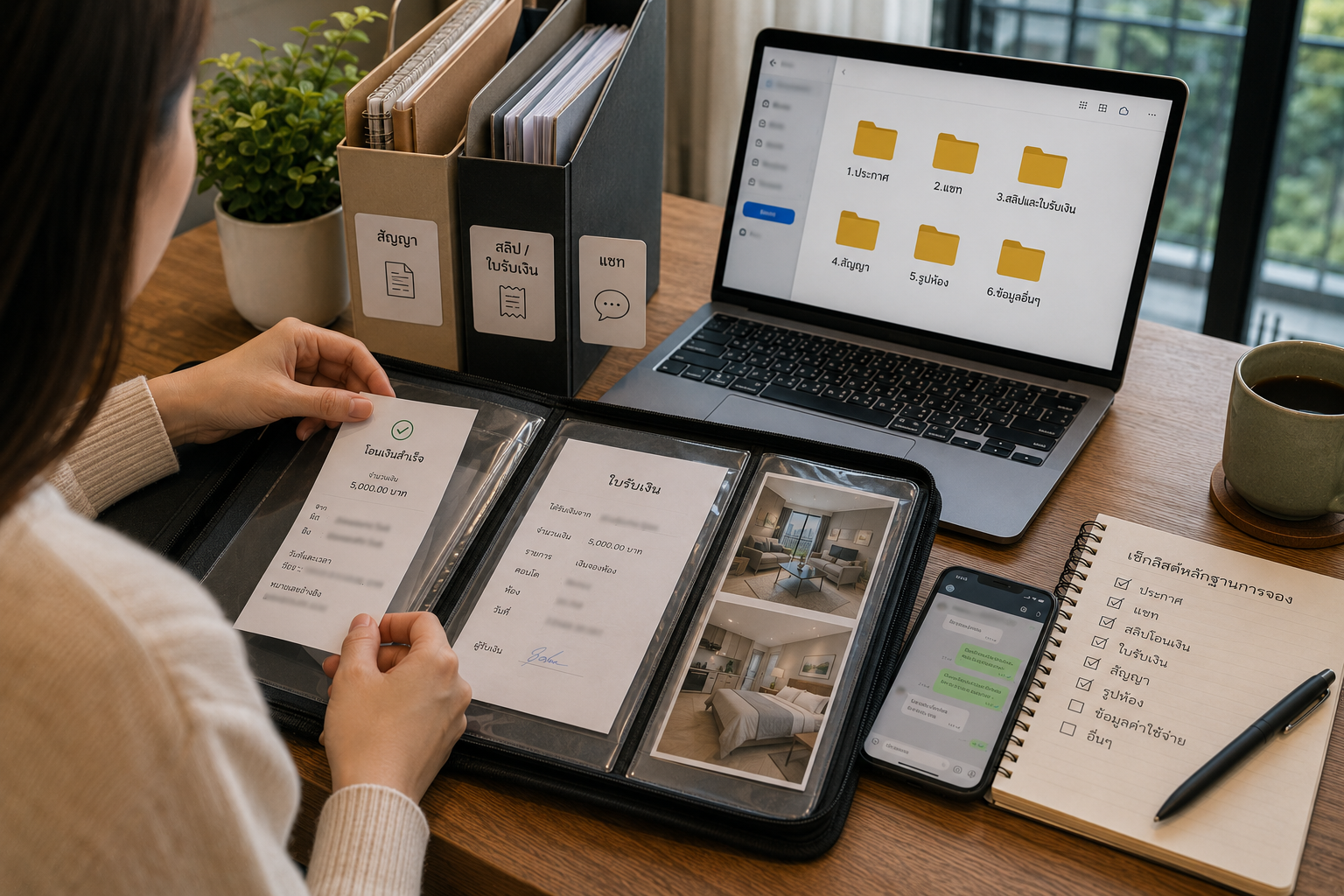
- You have viewed the actual room or had a live video call.
- Check that the room matches the listing.
- Check that the landlord has the right to rent it out.
- Check the recipient-account name.
- Ask what the transferred payment is for.
- Ask whether the payment is refundable and in which cases.
- Request written confirmation before transferring.
- Check the amount, account name, and account number before confirming.
- Save the transfer slip immediately after transferring.
- Request a receipt or confirmation message after transferring.
- Keep the listing, chats, transfer slips, lease, and room photos in the same folder.
Conclusion
A condo rental booking payment in Thailand should be transferred with evidence. Do not transfer money only because the room photos are attractive, the price is good, or you are pressured to book quickly. Tenants should view the actual room or have a live video call, verify the landlord and recipient account, request written confirmation before transferring, clearly state the transfer purpose, keep the transfer slip, request a receipt, and save chats at every step.
If the payment relates to a lease, security deposit, or advance rent, read the lease and refund terms clearly before paying. Baandeego is only a real estate listing platform and is not involved in bookings, receiving money, refunds, contracts, or checking recipient accounts on behalf of users.
English summary: Tenants should only pay a condo reservation deposit after verifying the room, landlord, bank account, written terms, receipt, and proof. Keep all records until the lease ends and the deposit is settled.
FAQ
1. Should I Transfer a Condo Booking Payment Before Viewing the Room?
In general, view the actual room or have a live video call before transferring money. If you have not viewed the room and the landlord pressures you to transfer immediately, be cautious and check further before deciding.
English: It is better to view the room or request a live video call before paying.
2. Is a Condo Booking Payment Refundable?
It depends on the agreement in each case. Before transferring, ask clearly whether the booking payment is refundable, in which cases it will be refunded, and in which cases it will not, and keep the written confirmation as evidence.
English: Refundability depends on the agreement. Confirm refund terms in writing before paying.
3. What Should I Keep After Transferring a Booking Payment?
Keep the transfer slip, chats, receipt or confirmation message, recipient-account details, listing screenshots, room photos, and the lease or draft lease in the same folder.
English: Keep transfer slips, chat records, receipt confirmation, bank details, listing screenshots, room photos, and lease documents.
Platform Use Disclaimer
This website is only a real estate listing platform.
Users should verify information, documents, and conditions by themselves.
This website is only a real estate listing platform.
Users should verify information, documents, and conditions by themselves.
Baandeego is not a broker and is not a party to any rental, purchase, sale, booking, payment, contract, ownership transfer, room inspection, document check, owner verification, recipient-account check, deposit receipt, refund, or coordination on behalf of users. It is not responsible for disputes among users, buyers, tenants, owners, sellers, landlords, agents, juristic persons, banks, service providers, or relevant authorities. All parties should independently verify the information, documents, terms, costs, and applicable laws before making a decision.
References
- Office of the Consumer Protection Board, Thailand: https://www.ocpb.go.th/index_en.php
- Thai Police Online: https://www.thaipoliceonline.go.th/
- Department of Lands, Thailand: https://www.dol.go.th/