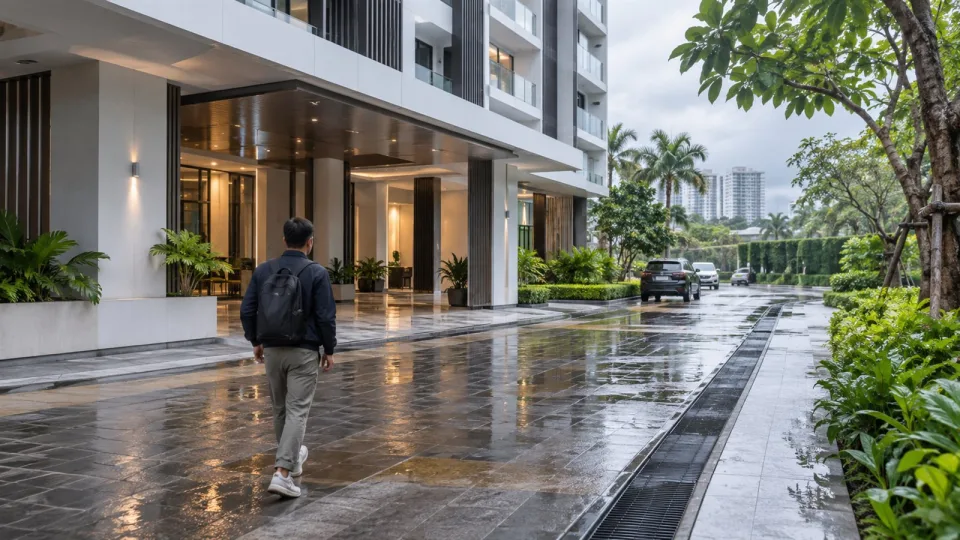
Information checked on 9 September 2026: When renting a condominium in Pattaya during the rainy season, do not judge the property only by its price, sea view or interior design. Rain can reveal issues that may be difficult to see on a dry day, including standing water on the access road, persistent musty odours, seepage around windows, poor balcony drainage and difficult transport during heavy downpours.
This article is a practical first-stage inspection guide for tenants. It is not an engineering report, a guarantee that a building will remain flood-free or legal advice. Inspect the actual unit, speak with the condominium management office and read the lease before paying a deposit.
Quick answer: what should you check during Pattaya's rainy season?
Check seven main areas: the route from the main road, low points and standing water, the entrance and parking areas, signs of leaks inside the unit, balcony drainage, dampness or musty odours, and the repair process written into the lease. If it is safe, view the property during light rain or within a few hours after rain stops. Drainage and seepage are often easier to assess then than on a dry day.
Why is a rainy-season viewing useful in Pattaya?
The Thai Meteorological Department places Pattaya in its Eastern-region weather coverage and provides a dedicated Pattaya page with station rainfall, a seven-day forecast and current warnings. TMD's climate information says that rainfall over upper Thailand generally reaches its highest levels in August or September, while the Eastern region is among the areas influenced by the southwest monsoon.
As a recent example, TMD's July 2026 monthly summary reported that rainfall in the Eastern region was 106.5 millimetres, or 37%, above normal for that month. One monthly statistic cannot determine the risk of a particular condominium. It does show why a tenant should examine current weather information and actual site conditions instead of relying only on a verbal statement that an area “never floods.”
1. Inspect the route from the main road to the building
Begin with the route you will actually use, not only the landscaped area in front of the project. After rain, travel from the main road, convenience store or workplace to the condominium. Look for low sections, underpasses, narrow sois, drainage inlets and road segments that may be difficult for small cars or motorcycles.
- Is there standing water between the main road and the project entrance?
- Can pedestrians reach the building without walking through water?
- Can taxis, delivery drivers and emergency vehicles reach the entrance normally?
- Is there an alternative route if the main soi is congested or waterlogged?
- Are walkways adequately lit and slippery when wet?
Old map photos and reviews may not represent conditions during current rain. Inspect the route yourself and, when possible, ask more than one resident about access after heavy rain.
2. Check the entrance, parking and common areas
A tall building does not mean that every part of the property is unaffected by rainwater. Pay particular attention to basement parking ramps, ground-floor lift lobbies, entrance doors, drainage channels and vehicle drop-off areas.
- Does the parking ramp have drainage channels and a raised water barrier?
- Are there sediment marks, water stains or recent repairs on lower-level walls?
- Are there ceiling drips in lift waiting areas or corridors?
- During rain, do lifts, access doors, lighting and water pumps operate normally?
- How does the management office communicate warnings or access changes?
Staff explanations are useful background information, but they are not a guarantee. View the relevant areas and record your observations before deciding.
3. Inspect the unit systematically for leaks
New seepage may not yet have formed a dark stain. Use sight, smell and touch around window frames, balcony doors, ceiling edges, wall corners, behind curtains, under sinks, around air-conditioner drain lines and behind wardrobes placed against external walls.
- Is paint blistered, wallpaper lifting or plaster discoloured?
- Is sealant around glazing cracked, separated or darkened?
- Is there a musty smell when the room or wardrobe is first opened?
- Is flooring near the balcony door swollen, slippery or water-marked?
- Does an air-conditioner drain drip inside or flow back toward the unit?
If you find a mark, photograph it with the date and ask whether the source has been repaired, who will be responsible and how the existing condition will be recorded in the handover document.
4. Check the balcony, windows and drainage
Balconies receive direct rain and wind, especially on higher floors or wind-facing sides of a building. Check whether the floor slopes toward the drain, the drain is clear of leaves and debris, and the door threshold helps prevent water from entering the room.
- With permission, can a small amount of water be used to observe drainage?
- Does water flow to the drain or remain in a puddle?
- Are there cracks, rust marks or loose finishes around balcony walls and rails?
- Do windows and doors close tightly against wind-driven rain?
- Does air-conditioner drainage avoid walkways and neighbouring units?
Do not pour large amounts of water or dismantle building components. This is only an initial observation. Ask the owner or management office to arrange a qualified inspection if anything appears abnormal.
5. Separate temporary humidity from a persistent moisture problem
Humid air after rain is not the same as repeated wet walls, a persistent musty odour or mould that returns after cleaning. World Health Organization guidance identifies prevention or minimisation of persistent dampness and microbial growth as an important way to reduce health risks in buildings.
- Does the odour become stronger when the air conditioner starts?
- Are wardrobes, mattresses and the backs of furniture dry?
- Does the bathroom have adequate mechanical or natural ventilation?
- Has a stain apparently been painted over without repairing the water source?
- Can the owner provide evidence of previous leak repairs or inspection?
Anyone with respiratory symptoms, allergies or a health concern should seek appropriate medical advice. This guide should not be used as a diagnosis.
6. Put repair procedures and responsibilities in writing
Before signing, ask the lease to identify the repair-reporting channel, expected response process, responsibility for costs and the procedure if a leak comes from the building exterior or a common system. Do not rely only on a verbal promise.
- Should the tenant report problems by LINE, email or a building application?
- Who may enter the unit to inspect it and how much notice is required?
- Are all existing marks included in the handover inventory?
- What happens if furniture must be moved or part of the unit cannot be used?
- Could an existing moisture mark be deducted from the deposit, and what evidence will prevent that misunderstanding?
Contracts and facts differ between properties. If a term is unclear or a dispute arises, obtain advice from an appropriate authority or qualified professional before signing or paying.
7. A 20-minute viewing checklist after rain
- Photograph the soi entrance, drop-off point and parking ramp.
- Observe drains and standing water without entering moving water or unsafe areas.
- Notice the smell immediately after opening the unit and wall-side wardrobes.
- Check window frames, balcony doors, ceiling edges and wall corners.
- Observe the balcony floor and drain without dismantling anything.
- Run the air conditioner briefly and check noise, odour and dripping.
- Ask management about lifts, power, pumps and warning procedures during heavy rain.
- Record all existing marks and attach them to the handover inventory.
Combine rainy-season checks with price and location
A cheaper unit may cost more in time and inconvenience if access becomes difficult after rain or an unresolved moisture problem requires repeated repairs. Use this checklist together with the 2026 Pattaya condo rent guide and the comparison of Central Pattaya, Jomtien and Pratumnak.
For deposits, utilities and general contract steps, read the complete Pattaya condo rental guide. You can then compare current rental listings and reconfirm every important detail directly with the lister.
Bottom line
Viewing a Pattaya condo after rain can reveal access, drainage, seepage and dampness under conditions closer to real use. One viewing cannot guarantee that a unit or building will remain problem-free. Check TMD weather information, inspect the site, speak with management, document the unit's condition and put the repair process in writing before paying.
FAQ
Should I view a Pattaya condo while it is raining?
If travel is safe, a viewing during light rain or shortly after rain stops can make standing water, seepage and drainage easier to assess. Do not travel during severe warnings or approach moving water, electrical equipment or restricted areas.
Are lower-floor condo units always riskier than high-floor units?
No. Lower floors may be more affected by entrances and common areas, while high floors may experience wind-driven rain, external-wall leaks or roof-related problems. Inspect the actual position and building systems.
Is a slight musty smell after rain normal?
A single smell is not enough to reach a conclusion. Check for recurring damp walls, stains, blistered paint and odours, and ask about repair history. Arrange a qualified inspection if you remain concerned.
Is a landlord's statement that an area has never flooded sufficient?
No. Inspect the route, ask the management office and more than one resident, look for physical marks in common areas and review current official weather information.
Sources and methodology
This guide combines practical property-inspection steps with official information checked on 9 September 2026: the Thai Meteorological Department Pattaya weather page, TMD monthly climate summaries, TMD weather warnings, and the WHO guidelines on indoor dampness and mould. Every building and unit must still be inspected individually.