What to Check Before Signing a Condo Room Handover
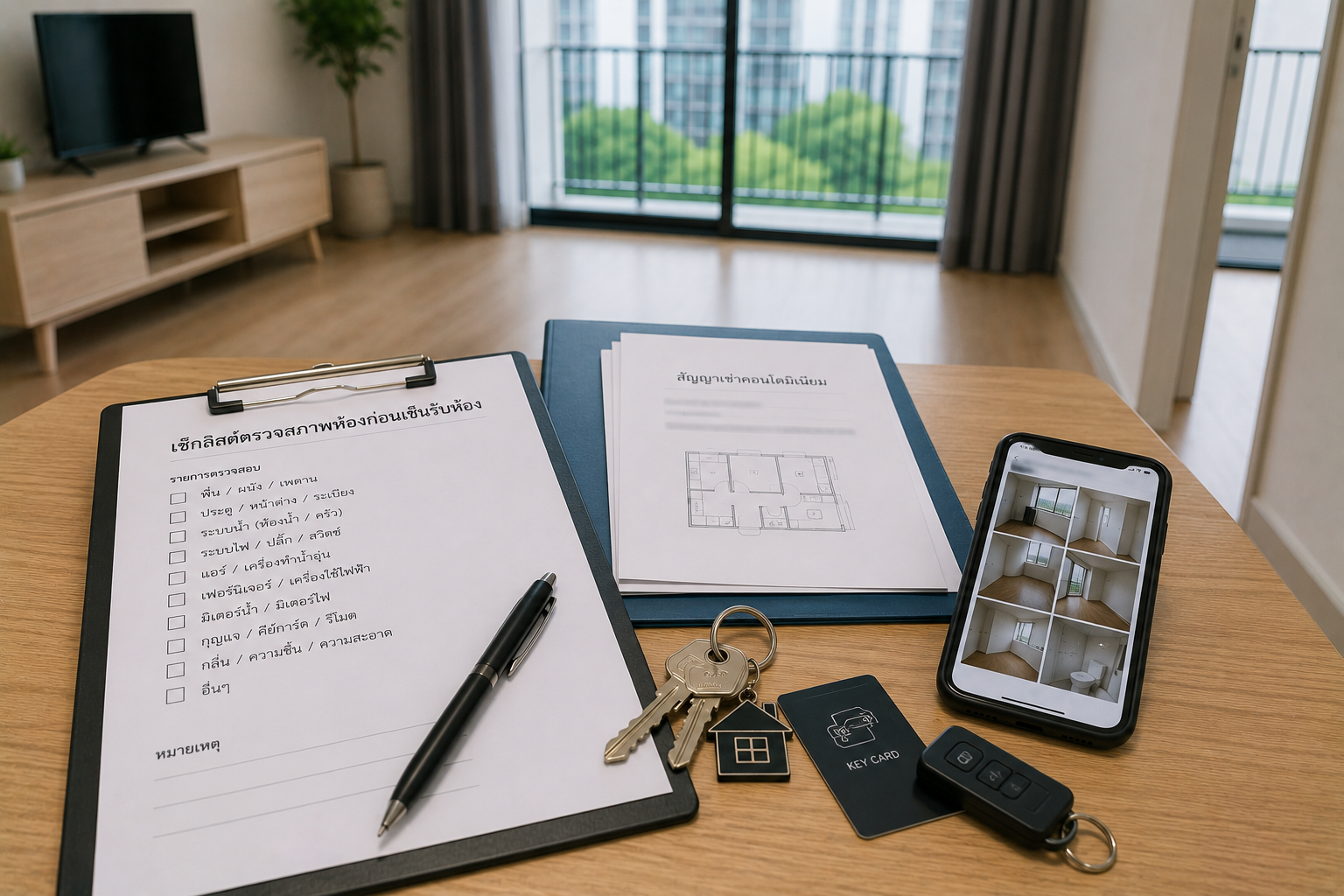
Inspecting the condition of a rental condo before signing the room handover is an important step that tenants should not overlook. A handover document or confirmation in chat may be used as evidence of the room's condition on the move-in date. If a tenant signs for the room without inspecting it carefully, problems may arise later, such as deductions from the security deposit for pre-existing marks, an air conditioner that was broken before move-in, an existing water leak, or damaged furniture with no supporting evidence.
The condition inspection should be systematic. Take photos and videos and make a complete list of problems before placing belongings in the unit or actually moving in. Whether renting a condo in Bangkok, Pattaya, Chonburi, Phuket, Chiang Mai, or another province, tenants should notify the owner or landlord in writing immediately if they find a problem. Both parties should confirm how it will be repaired, who is responsible for the cost, and when the work will be completed.
English summary: Before signing a condo room handover form in Thailand, tenants should inspect the room condition, record evidence, list defects, and confirm repair responsibility in writing.
1. Do Not Rush to Sign Before Actually Inspecting the Room
Many tenants rush to sign the room handover because they want to move their belongings in quickly, but signing before an inspection may make it difficult to establish the original condition later. Ask for time to walk through the room, turn on the water, electricity, and air conditioner, and check the inventory before signing or transferring the remaining payment.
- Read the room handover document or condition inspection form before signing
- Check whether there is space to record problems or exceptions
- If you find a problem, record it in the document or chat before signing
- Do not sign a statement that the "room is complete" if you have not finished the inspection
- Always request a copy of every document you sign
If the owner or person handing over the room pressures you to sign without allowing an inspection, be cautious and ask them to record in writing whether the tenant may conduct an additional inspection within an agreed period.
English summary: Do not sign that the room is complete before inspecting it. Add defects to the document or chat record first.
2. Record One Continuous Walk-Through Video
A continuous video shows the overall condition of the room well because it records the inspection route and the location of each problem. Record it before placing boxes or personal belongings in the unit so the floors, walls, ceiling, furniture, and electrical appliances are clearly visible.
- Start recording at the unit door and walk around the entire room
- Record the living room, bedroom, kitchen, bathroom, and balcony
- Zoom in on damage such as water marks, swelling, cracks, or scratches
- Say the date and time in the video, if convenient
- Keep the file in the cloud or in a dedicated folder
A video should not replace all photos. Photos are still necessary for specific damage, such as marks on the floor or walls and water or electricity meter readings.
3. Inspect the Floors, Walls, Ceiling, and Balcony
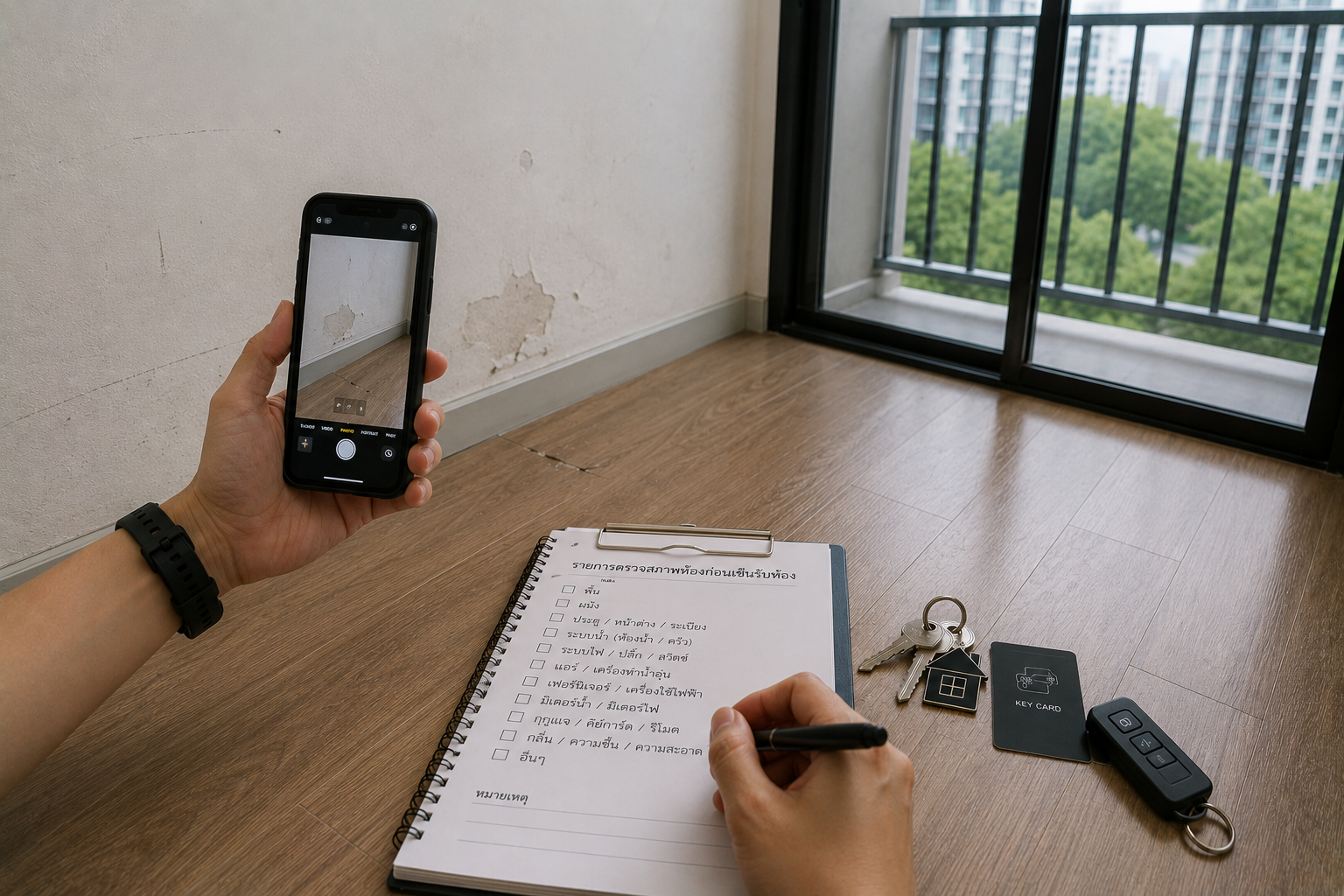
Floors, walls, ceilings, and balconies are often involved in security deposit disputes because scratches, cracks, water marks, or swelling may be attributed to the tenant. Photograph any pre-existing marks and notify the owner immediately on the room handover date.
- Does the floor have scratches, swelling, or cracks?
- Do the walls have water stains, drill holes, or peeling areas?
- Does the ceiling have water stains or signs of previous repairs?
- Does the balcony have standing water, broken tiles, or a blocked drain?
- Are the balcony door and railing in a safe condition?
If you find water stains on the ceiling or walls, ask the owner whether there is a history of leakage. If you suspect that it involves a building system, ask a technician or the juristic office to inspect it.
English summary: Floors, walls, ceilings, and balconies are common deposit dispute points. Photograph all existing marks before signing.
4. Check Doors, Windows, and Locks
Doors, windows, and locks affect both safety and everyday convenience. Open and close every door and window, test every lock, and check for stiffness, cracks, or loose hardware.
- Does the main door lock securely?
- Do the doorknob, bolt, security chain, and peephole work?
- Do all windows open and close?
- Does the balcony sliding door move smoothly and lock?
- Are the seals around the doors or windows deteriorated, or are there air gaps?
- Are the insect screens or curtains damaged, if the room has them?
If a lock is broken on the first day, notify the owner immediately. In a rental unit, do not replace a lock or install permanent equipment yourself without permission.
5. Check the Water, Bathroom, and Kitchen
The water system requires a detailed inspection because a small leak can turn into major damage. Turn on every tap, inspect under the sinks, test the toilet and drains, and check for odors coming from the pipes.
- Do any kitchen or bathroom taps leak?
- Are there water stains or drips under the sinks?
- Does the toilet flush normally without leaking?
- Do the bidet sprayer and shower work?
- Do the drains flow well, without standing water?
- Does the water heater work, if provided?
PWA provides tap water in many provincial areas, while some condos may bill water through the juristic office or unit owner. Tenants should clearly ask how the water charge is calculated and when it is billed before actually moving in.
English summary: Test all water points, drains, toilet, sink, shower, and water heater before signing the room condition form.
6. Check Lights, Outlets, Switches, and the Breaker
Inspect the electrical system safely by turning on every light, testing each switch, and checking outlets with a safe, low-power device. If you find a loose outlet, scorch marks, flickering lights, or a tripping breaker, stop using that point and notify the owner immediately.
- Do all lights turn on?
- Do all switches work?
- Are the outlets powered and secure?
- Are there scorch marks, a burning smell, or unusual sounds?
- Is the breaker in normal condition?
- Do the electrical appliances supplied with the room work?
MEA provides information about electricity use and services in the metropolitan area, while PEA is responsible for electricity distribution in many provincial areas. For the latest billing and service information, users should contact the electricity authority responsible for their area directly.
7. Test Every Air Conditioner and Remote Control
Air conditioners should be checked carefully before signing for the room because repair or cleaning costs may become a source of dispute. Run every unit for at least 15-30 minutes and check the cooling, noise, dripping water, smell, and remote control.
- Does the air conditioner actually cool the room?
- Is there dripping water or a water stain beneath it?
- Is there a musty, damp, or burning smell?
- Does the unit or compressor make an unusual noise?
- Can the remote turn the unit on and off, adjust the temperature, and change modes?
- When was it last cleaned, and is there a receipt?
If the owner agreed to have the air conditioner cleaned before move-in, request evidence such as a receipt or post-cleaning photos. The lease or chat should also clearly state the conditions for air-conditioning cleaning costs.
English summary: Test every air conditioner before signing. Check cooling, water drip, smell, noise, remote control, and cleaning history.
8. Inspect the Furniture and Inventory
Rental condos often have an inventory attached to the lease, listing items such as the bed, mattress, wardrobes, tables, sofa, television, refrigerator, microwave, washing machine, or water heater. Tenants should compare the actual items with the list and record all damage before signing the handover.
- Is all furniture on the list present?
- Are there tears, dents, stains, or cracks?
- Do the drawers, hinges, and handles work?
- Do the mattress, sofa, or curtains have stains or odors?
- Do the electrical appliances actually turn on and work?
- Are all remote controls, accessories, and manuals present?
If the contract inventory does not match the actual contents of the room, revise the list before signing or ask the owner to confirm in chat what is missing, what is broken, and how it will be resolved.
9. Check Water and Electricity Meters and Unpaid Bills
Before signing for the room, photograph the water and electricity meter readings and ask whether any bills from before the move-in date remain unpaid. A tenant should not be responsible for expenses incurred before the contract starts. If a different arrangement applies, it should be stated clearly in the contract.
- Photograph the electricity meter with the reading clearly visible
- Photograph the water meter with the reading clearly visible
- Ask whether any bills from before move-in remain unpaid
- Ask whether electricity is billed at the actual utility rate or a rate set by the owner
- Ask whether water is billed through the juristic office or waterworks authority
- Send the meter readings to the owner in chat and retain them
Electricity and water may be billed by government authorities, the juristic office, or the unit owner, depending on the building and lease. Tenants should clarify this before signing the handover and paying the remaining balance.
English summary: Photograph water and electricity meters, check unpaid bills, and confirm billing method before signing.
10. Check Keys, Keycards, and Parking Cards
Keys and keycards are small but extremely important. Count and test every item before signing the room handover, because a missing or nonworking keycard may incur a charge or prevent access to the building.
- How many unit keys are provided?
- How many building and elevator keycards are provided?
- Is a parking card or vehicle sticker provided?
- Is there a mailbox key?
- Is there a gate remote or another access device?
- What is the replacement charge for a lost key or keycard?
Photograph all keys and keycards received and have the owner or person handing over the unit confirm the quantity in the document or chat.
11. Write Down All Problems Before Signing the Handover
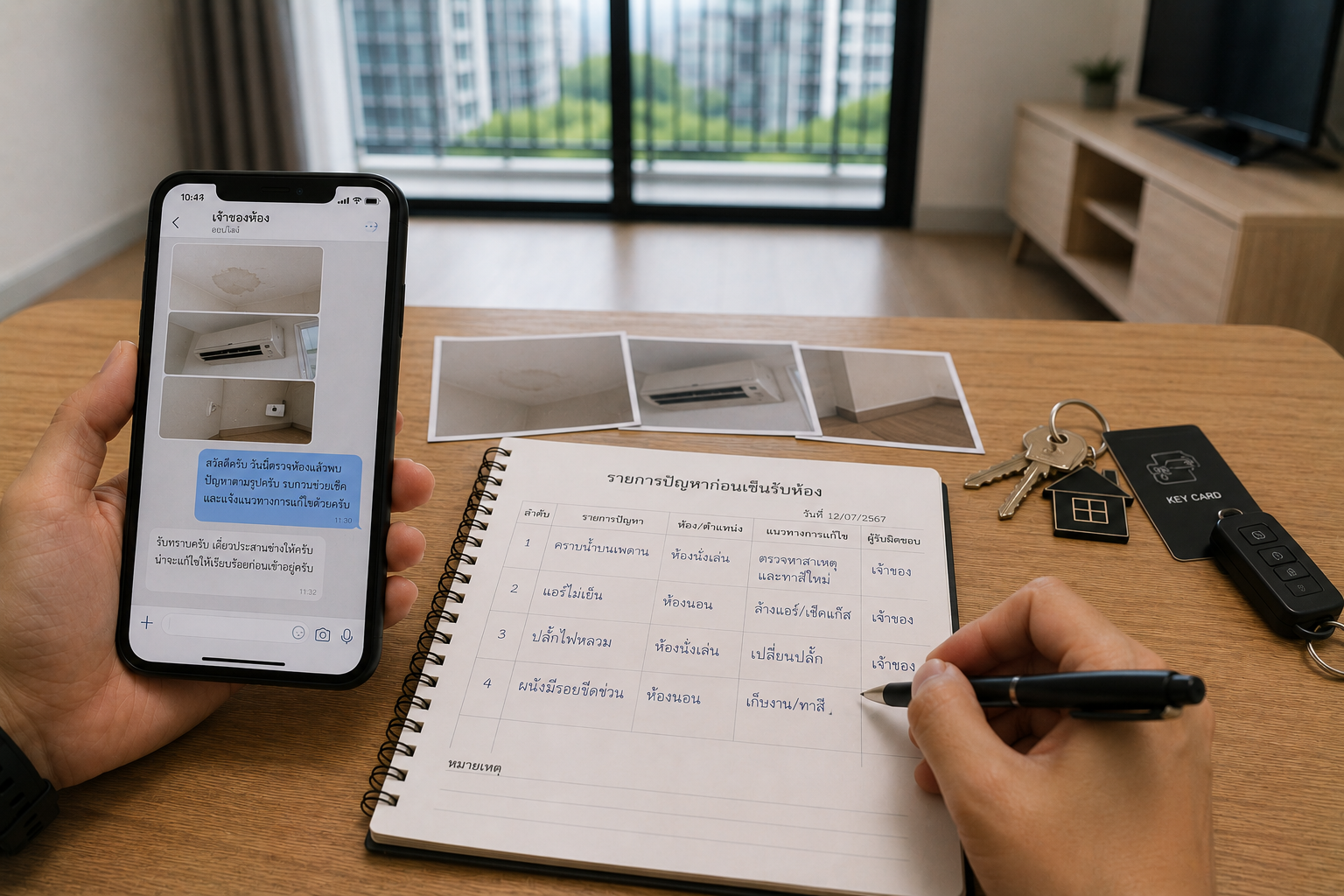
If you find any problem, record it in the handover document or send it in a message for the owner to confirm before signing. This distinguishes pre-existing damage from damage that may occur after move-in.
- Describe each problem clearly
- State the room or location, such as the bathroom, kitchen, balcony, or bedroom
- Attach supporting photos or videos
- Ask the owner to confirm whether it will be repaired
- Agree on who is responsible for the cost
- State the expected completion date if a repair is planned
If there is no room handover document, send the problem list in chat and ask the owner to respond clearly, for example, "Acknowledged" or "It will be repaired by [date]," so the record can be reviewed later.
English summary: Add all defects to the handover form or chat before signing. Ask the landlord to confirm repair responsibility.
12. Check Amounts and Evidence Before Paying the Remaining Balance
Before paying any remaining balance, such as the first month's rent, security deposit, keycard fee, or other expenses, check that every amount matches the contract and retain evidence of each payment. Do not pay cash without a receipt.
- Does the amount match the contract?
- What is each amount for?
- Whose name is on the receiving account?
- Is there a receipt or message confirming receipt of payment?
- Have the transfer slips and chat records been retained?
- Are there any charges not stated in the contract?
If a dispute arises over a service or payment, OCPB is Thailand's consumer protection agency and users may consult it for more information. Resolution of a specific dispute should, however, be based on the relevant contract, evidence, and facts.
13. Rental Condo Condition Checklist Before Signing the Handover
- Read the room handover document before signing
- Record one continuous walk-through video
- Photograph the floors, walls, ceiling, and balcony
- Check the doors, windows, and locks
- Check the water, bathroom, kitchen, and drains
- Check the lights, outlets, switches, and breaker
- Run every air conditioner and test each remote
- Inspect the furniture and inventory
- Photograph the water and electricity meters and ask about unpaid bills
- Count the keys, keycards, and parking cards
- Write down all problems before signing the handover
- Check the amounts and retain proof of payment
Summary
Inspecting a rental condo before signing the room handover is an important way to prevent disputes over the security deposit, repair costs, and room condition after move-out. Before signing the handover document, tenants should inspect everything: floors, walls, ceilings, doors, windows, water, electricity, air conditioners, furniture, appliances, meters, keys, and keycards.
If you find a problem, record it in the document or send it in chat with photos and videos. Ask the owner or landlord to confirm it before you sign the handover or pay the remaining balance. Evidence from the first day will make it easier for both parties to review the facts if a dispute arises later.
English summary: A room condition checklist protects both tenant and landlord by recording the unit’s condition before move-in and before signing the handover form.
FAQ
1. Should you sign for the room before or after inspecting its condition?
Always inspect the room before signing the handover. If you find a problem, record it in the handover document or send it in chat for the owner to confirm before signing. This helps prevent later disputes over the security deposit and repair costs.
English: Inspect the room before signing and record all defects first.
2. What should you do if the room has pre-existing marks?
Immediately photograph and record videos of the existing marks, state their locations clearly, and send the evidence to the owner or landlord on the handover date. If there is a handover document, record the existing marks in it before signing.
English: Photograph and list all existing marks before signing the handover form.
3. Do you need to check the water and electricity meters before signing for the room?
Check and photograph the water and electricity meters before signing to confirm the tenant's starting readings. Also ask whether any bills from before move-in remain unpaid and how the contract calculates water and electricity charges.
English: Yes, meter photos help confirm your starting utility readings.
Platform Use Disclaimer
This website is only a platform for real estate listings.
Users should verify all information, documents, and conditions themselves.
This website is only a real estate listing platform.
Users should verify information, documents, and conditions by themselves.
Baandeego is not a broker and is not a party to any rental, purchase, sale, booking, payment, contract, ownership transfer, room inspection, document review, meter inspection, repair, or other service. It is not responsible for disputes among users, buyers, tenants, owners, sellers, landlords, service providers, juristic persons, or other involved parties. Before making a decision, all parties should independently verify the information, documents, conditions, costs, and applicable laws.
References
- Metropolitan Electricity Authority — Electricity Saving Tips: https://www.mea.or.th/en/electricity/energy-saving-tips/
- Provincial Electricity Authority — Business & Service: https://www.pea.co.th/en/about-pea/pea-service
- Provincial Waterworks Authority: https://en.pwa.co.th/
- Office of the Consumer Protection Board, Thailand: https://www.ocpb.go.th/index_en.php